Publications
2026
Consumer Climate: War with Iran Weighs on Consumer Sentiment
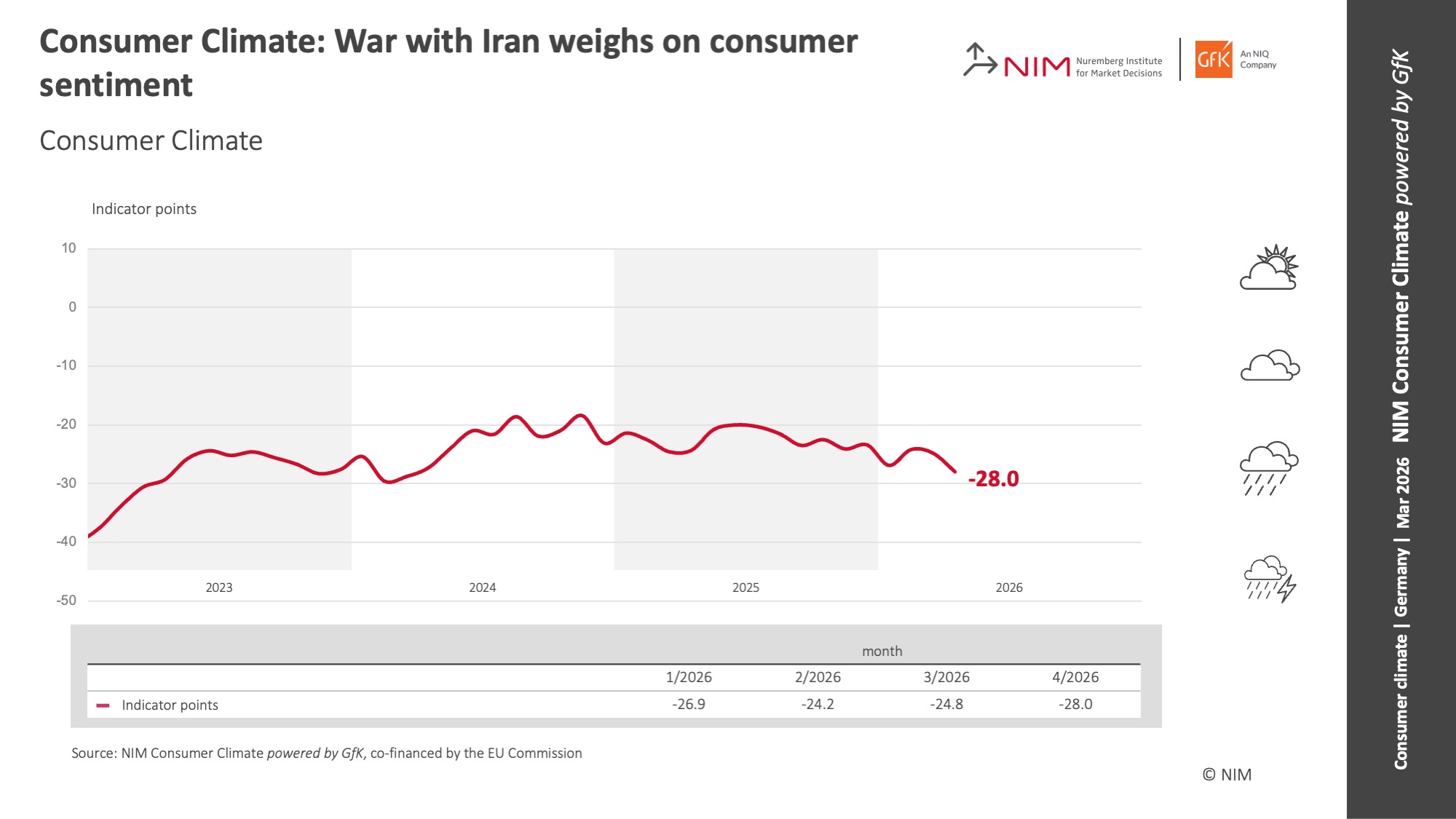
Nuremberg, 26 March 2026 – The war in Iran is dampening consumer sentiment. According to consumer expectations, the Consumer Climate indicator for April 2026 decreases to -28.0 points. This represents a decrease of 3.2 points compared with the previous month (revised to -24.8 points). Whilst no significant effects are yet visible in terms of the willingness to buy or save this month, income expectations are noticeably dampened because of inflation fears. This is shown by the latest results of the NIM Consumer Climate powered by GfK, which has been published jointly since October 2023 by the Nuremberg Institute for Market Decisions (NIM), founder of GfK, and NIQ/GfK.
Significant decrease in income expectations
Consumer income expectations, which had been positive again since the start of the year, have fallen significantly by 12.6 points and are now back in negative territory (-6.3 points). This development is likely to be driven, on the one hand, by the significant downturn in economic expectations. On the other hand, rising energy prices are fueling inflation fears among the public, causing price expectations to rise sharply.
The willingness to buy and the willingness to save show no signs of change yet
The willingness to buy remains largely unaffected by this month and, at -10.9 points, shows only moderate losses compared with the previous month. Similarly, the willingness to save, which reached a new high since 2008 in February, has stabilized for the time being in March at a very high level of 18.5 points.
“The decrease to -28 points indicates a noticeable downturn in consumer sentiment. Whilst the willingness to buy and the willingness to save are currently showing little reaction to the geopolitical events in Iran, consumers expect inflation to rise again due to higher energy prices, and the economic recovery to be slowed once more,” explains Rolf Bürkl, Head of Consumer Climate at NIM. “In a recent NIM study, 60 per cent of Germans state that they expect prices for oil, gas and petrol to remain high in the long term. This naturally has a negative impact on consumers‘ mood.”
The study, conducted in parallel with the Consumer Climate survey, also shows that consumer uncertainty is generally increasing as a result of the war in Iran: Over 90 per cent of respondents who expect a significant worsening in their income situation believe that the world will become more uncertain in the coming years as a result of the war.
Economic expectations are noticeably dampened
The war in Iran also leaves a clear impact on consumers’ economic outlook for the next 12 months. The indicator decreases by 11.2 points to -6.9 points. The last time a lower figure was measured was in December 2022, at -10.3 points.
Many consumers are clearly concerned that the modest recovery of the German economy could suffer a serious setback, particularly if the conflict were to last for a long time.
The following table shows the values of the individual indicators in March 2026 compared to the previous month and previous year:
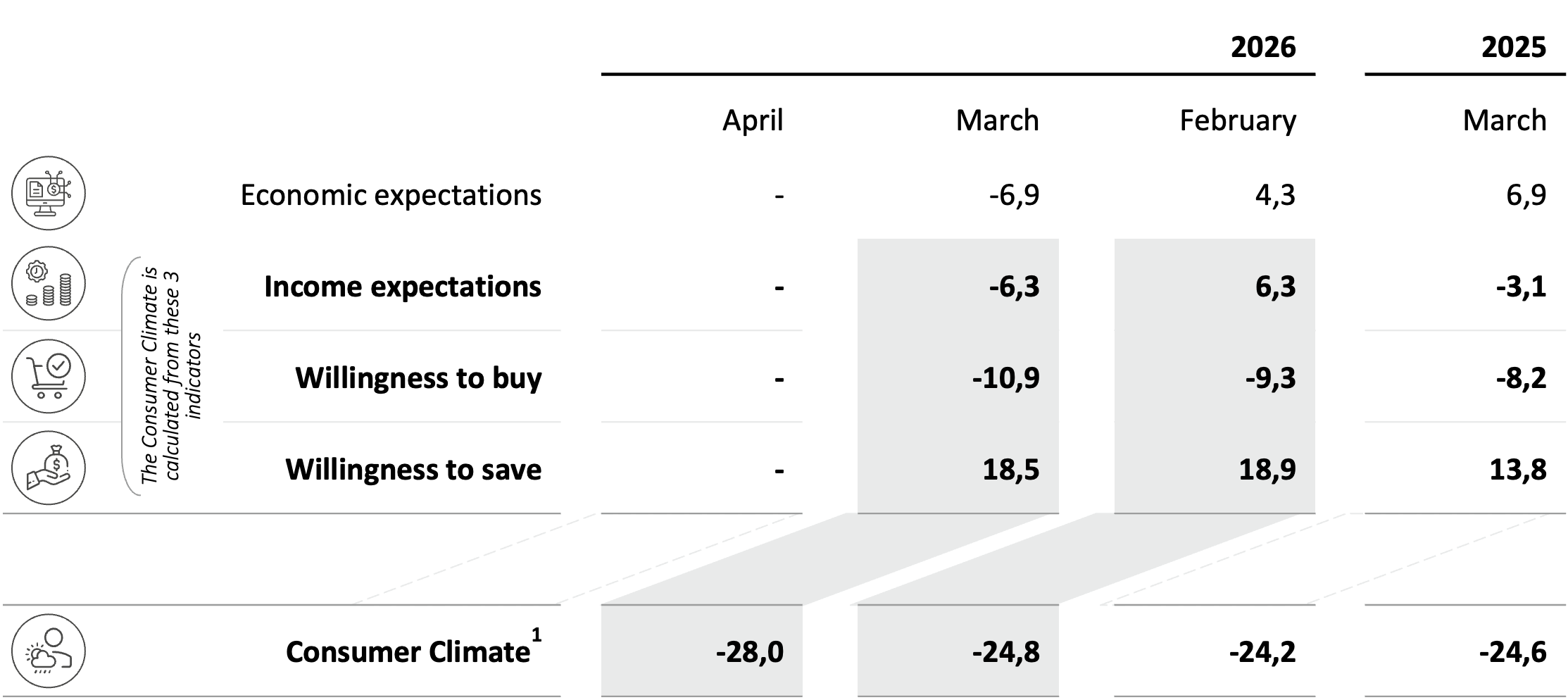
1Consumer Climate can be interpreted as a leading indicator of consumer behavior in Germany. Analyses have shown that sentiment is an early indicator for the actual development of private consumption. The Consumer Climate is calculated from the March values for income expectations, willingness to buy and willingness to save - as a leading indicator for the development of consumption in Apri 2026.
The following diagram shows the development of the Consumer Climate indicator over the last few years:
Planned publication dates in Q1/Q2 2026 (CET):
- Monday, April 27, 2026, 8:00 a.m.
- Friday, May 22, 2026, 8:00 a.m.
- Thursday, June 25, 2026, 8:00 a.m.
About the method
The survey period for the current analysis was from was from 5 to 16 March 2026.
The results are extracted from the “NIM Consumer Climate powered by GfK” study and are based on around 2,000 consumer interviews conducted on behalf of the European Commission. The report presents the indicators in the form of graphics accompanied by brief comments. Consumer sentiment refers explicitly to all private consumer spending. Depending on the definition used, however, retail accounts for only around 30 percent of private consumer spending. Services, travel, housing costs, healthcare services, and the wellness sector as a whole account for the rest. Again, this does not apply to retail sales, but instead to total consumer spending. Like all other indicators, willingness to buy is a confidence indicator. It indicates whether consumers currently consider it advisable to make larger purchases. Even if they answer “Yes” to this question, there are two further requirements for making a purchase: The consumer must have both money required for such a large purchase and must also see a need to make this purchase. Furthermore, this only concerns durable consumer goods that also require a larger budget.
NIM Consumer Climate powered by GfK
The GfK Consumer Climate survey, which is being conducted regularly since 1974 and monthly since 1980, is regarded as an important indicator of German consumer behavior and a guiding light for Germany’s economic development. Since October 2023, the Consumer Climate data collected by GfK has been analyzed and published jointly with the Nuremberg Institute for Market Decisions (NIM), the founder of GfK.
Media Contact:
NIM: Sandra Lades, T +49 911 95151 989, sandra.lades@nim.org
NIQ: Julia Mayer, T +351 932 640 305, julia.mayer@nielseniq.com
Nuremberg Institute for Market Decisions e. V.
The Nuremberg Institute for Market Decisions (NIM) is a non-profit research institute at the interface between science and practice. The NIM investigates how consumer decisions change as a result of new technologies, social trends or the application of behavioral science and what micro- and macroeconomic effects this has on the market and society. A better understanding of consumer decisions and their effects helps society, companies, politicians and consumers to make better decisions in the interests of a socio-ecological market economy and "prosperity for all".
The Nuremberg Institute for Market Decisions is the founder of GfK.
Further information at www.nim.org/en and LinkedIn.
GfK – a NielsenIQ company
For 90 years, clients around the world have trusted us to provide data-driven answers to key questions for their decision-making processes. We support their growth through our comprehensive understanding of buying behavior and the dynamics that influence markets, brands, and media trends. In 2023, industry leaders GfK and NielsenIQ have merged to offer their clients unparalleled global reach. With a holistic view of retail and the most comprehensive consumer insights, provided by forward-looking analytics on state-of-the-art platforms, GfK is driving “Growth from Knowledge.” More information is available at www.nielseniq.com.
About NIQ
NielsenIQ (NYSE: NIQ) is a leading consumer intelligence company, delivering the most complete and trusted understanding of consumer buying behavior and revealing new pathways to growth. By combining an unmatched global data footprint and granular consumer and retail measurement with decades of AI modeling expertise, NIQ builds decision systems that help companies turn complex data into confident action. With operations in more than 90 countries, NIQ covers approximately 82% of the world’s population and more than $7.4 trillion in global consumer spend. Through cloud-based platforms, advanced analytics and AI-driven insights, NIQ delivers The Full View™—helping brands and retailers understand what consumers buy, why they buy it, and what to do next.