Publications
2026
Consumer Climate: Significant Setback
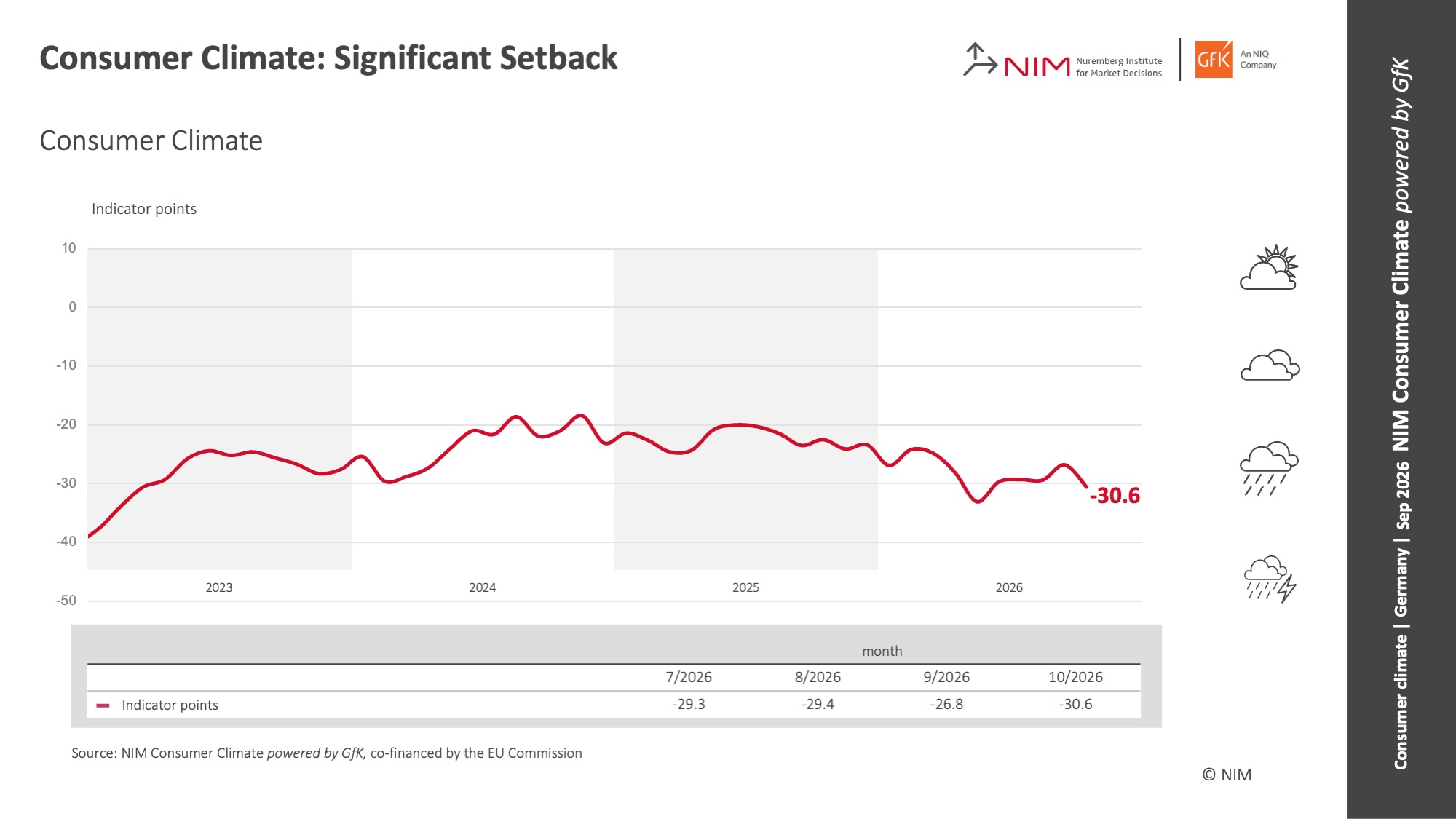
Nuremberg, 25 September 2026 – Consumer Climate in Germany shows a significant setback in September The Consumer Climate indicator for October has fallen by 3.8 points to -30.6 points (previous month revised: -26.8 points). This decrease is attributable not only to an increased willingness to save but, above all, to a significant drop in income expectations. The willingness to buy also fell slightly, whilst economic expectations remained virtually unchanged. These are the finding of the NIM Consumer Climate powered by GfK.
Income expectations dragged down by rising energy prices
The marked deterioration in Consumer Climate is largely attributable to the sharp decline in income expectations this month. The income expectations indicator fell by 16.7 points to -15.0 points. This is the lowest figure since April 2026, shortly before the introduction of the fuel rebate. At that time, the indicator stood at -24.4 points.
“The majority of households expect high energy prices to reduce their purchasing power,” explains Rolf Bürkl, Head of Consumer Climate at NIM. “As a result, they are more skeptical about their income expectations for the next twelve months.”
Rising willingness to save puts further strain on Consumer Climate
In addition to the decline in income expectations, the Consumer Climate in September is being weighed down by a noticeable increase in the willingness to save. Following a rise of 6.0 points, the indicator has climbed to 21.5 points. A similarly high level was last recorded during the financial and economic crisis of 2008. High energy prices are fueling uncertainty among consumers and leading them to believe that, given the general economic situation, it is currently advisable to save.
Further analyses by the NIM show that the willingness to save has increased more sharply, particularly in households with a strong financial position. These households appear to be seeking to offset the inflation-related loss of purchasing power of their savings by putting more money aside.
Willingness to buy has fallen slightly
In contrast to income expectations and the willingness to save, the willingness to buy remains broadly stable. The indicator has fallen by one point and now stands at -10.8 points. This is still just above the figure for the same month last year (September 2025: -11.6 points). However, the level remains extremely low and has been fluctuating around the -10-point mark for more than three years.
Economic expectations show a slight increase
Whilst income expectations are currently viewed with considerably more skepticism, consumers’ economic expectations continue to rise, albeit at a slower pace. The indicator has gained a further half a point and now stands at -3.4 points. This marks the fifth consecutive increase.
The German economy has recently proved to be surprisingly resilient, as shown by the growth in gross domestic product for the first half of 2026. Consequently, research institutes have revised their growth forecasts for this year and the next upwards. Growth rates in gross domestic product of just over one per cent are currently forecast for 2026 and 2027.
The following table shows the figures for the individual indicators in September 2026, compared with the previous month and the same month last year:
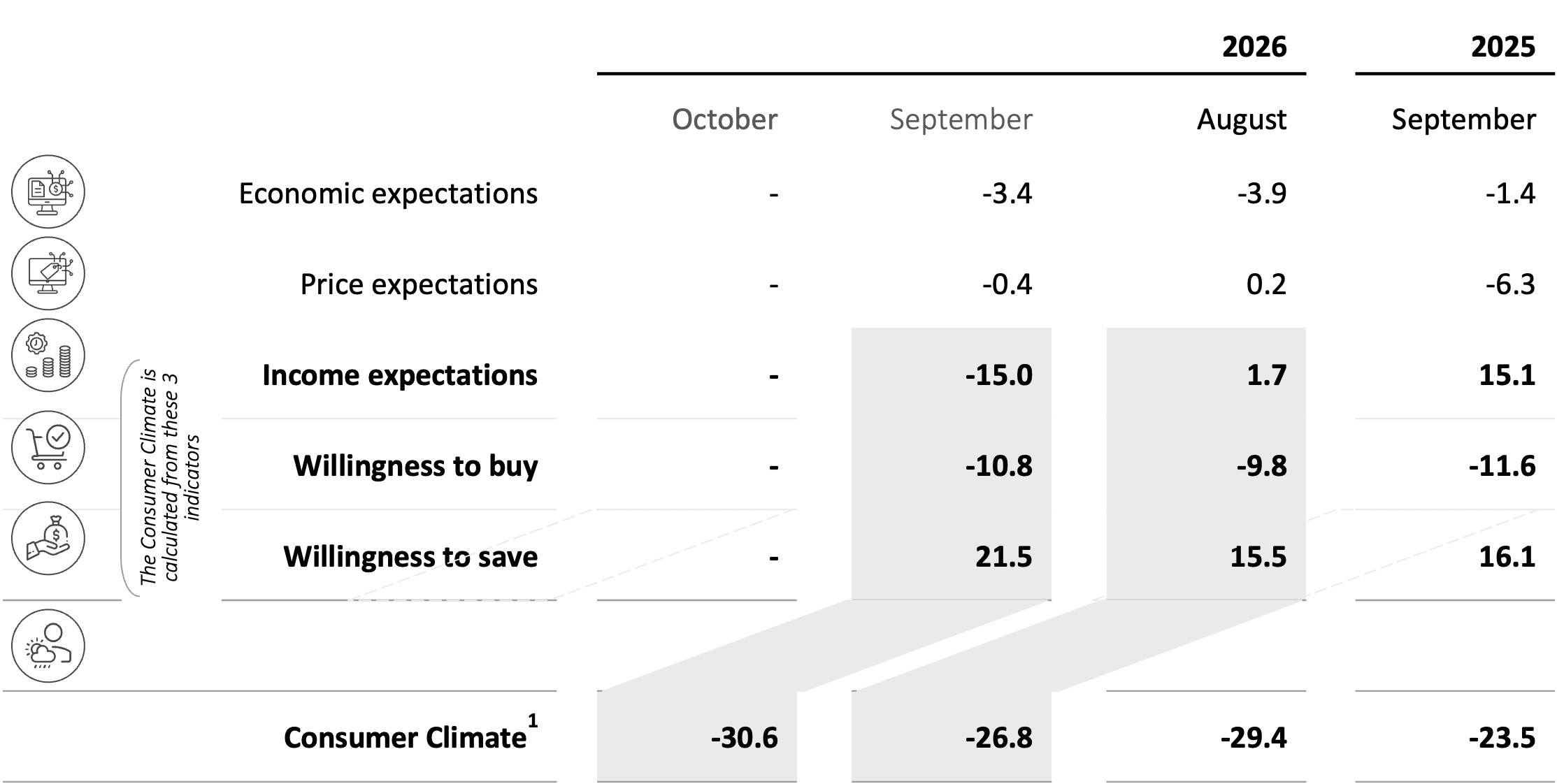
1 The consumer climate can be interpreted as a leading indicator of consumer behavior in Germany. Analyses have shown that sentiment is a leading indicator of the actual trend in private consumption. The consumer confidence index – as a leading indicator of the trend in consumption in October 2026 – is calculated from the figures for income expectations, willingness to buy and willingness to save recorded in September 2026.
The following diagram shows the development of the Consumer Climate indicator over the last few years:
Planned publication dates in Q3/Q4 2026 (CET):
- Wednesday, October 28, 2026, 8:00 a.m.
- Thursday, November 26, 2026, 8:00 a.m.
- Friday, December 18, 2026, 8:00 a.m.
About the Method
The survey period for the current analysis was from 3 to 14 September 2026.. The results are extracted from the “NIM Consumer Climate powered by GfK” study and are based on around 2,000 consumer interviews conducted on behalf of the European Commission. The report presents the indicators in graphical form, accompanied by brief comments. Consumer sentiment refers explicitly to all private consumer spending. However, depending on the definition used, retail accounts for only about 35 percent of private consumer spending.
The three indicators used to calculate the consumer climate indicator:
- Income expectations: Shows how consumers rate the development of their household’s financial situation over the next 12 months.
- Willingness to save: Reflects consumers’ opinion on whether it is currently advisable to save, given the general economic situation.
- Willingness to buy: Shows the extent to which consumers consider it favorable to make major purchases (furniture, electrical/electronic appliances, etc.) given the general economic situation.
Macroeconomic indicators:
- Economic expectations: Determines consumers’ assessment of how the general economic situation in Germany will develop over the next 12 months.
- ·Price expectations: Asks how consumers believe consumer prices will develop over the next 12 months compared to the past 12 months.
Note on the indicators: These are subjective sentiment indicators, not direct behavioral data. Actual behavior (purchases, saving, income) also depends on liquidity, necessity, prices, and individual circumstances.
NIM Consumer Climate powered by GfK
The Consumer Climate survey, which is being conducted regularly since 1974 and monthly since 1980, is regarded as an important indicator of German consumer behavior and a guiding light for Germany’s economic development. Since October 2023, the Consumer Climate data collected by GfK has been analyzed and published jointly with the Nuremberg Institute for Market Decisions (NIM), the founder of GfK.
As part of a reorganization of responsibilities, starting in April 2026, the NIM took over not only the evaluation and analysis of the Consumer Climate but also all communication related to it. From this point on, the study is published under the name “NIM Consumer Climate powered by GfK” thereby returning fully to the NIM, which was responsible for the study until 1984 (then known as GfK Verein). Since June 2026, NIM has complemented its monthly reporting with the Consumer Climate Socio. Published a few days after the NIM Consumer Climate each month, it provides insights into how consumer sentiment is developing across different sociodemographic groups.
All data will continue to be collected by NIQ/GfK on behalf of the NIM. The methodology, data collection, and analysis remain unchanged.
Media Contact:
NIM: Sandra Lades, T +49 911 95151 989, sandra.lades@nim.org
Nuremberg Institute for Market Decisions
The Nuremberg Institute for Market Decisions (NIM) is an independent, non-university-affiliated economic research institute. We examine the consumer climate and consumer behavior as a driving force of the economy. Based on academic excellence, we formulate concrete recommendations to help politics, businesses, and society make better decisions.
We finance our research with our own funds.
The Nuremberg Institute for Market Decisions is the founder of GfK.
Further information at www.nim.org/en and LinkedIn.
GfK – a NielsenIQ company
For 90 years, clients around the world have trusted us to provide data-driven answers to key questions for their decision-making processes. We support their growth through our comprehensive understanding of buying behavior and the dynamics that influence markets, brands, and media trends. In 2023, industry leaders GfK and NielsenIQ have merged to offer their clients unparalleled global reach. With a holistic view of retail and the most comprehensive consumer insights, provided by forward-looking analytics on state-of-the-art platforms, GfK is driving “Growth from Knowledge.” More information is available at www.nielseniq.com.
NielsenIQ (NYSE: NIQ) is a leading consumer intelligence company, delivering the most complete and trusted understanding of consumer buying behavior and revealing new pathways to growth. By combining an unmatched global data footprint and granular consumer and retail measurement with decades of AI modeling expertise, NIQ builds decision systems that help companies turn complex data into confident action. With operations in more than 90 countries, NIQ covers approximately 82% of the world’s population and more than $7.4 trillion in global consumer spend. Through cloud-based platforms, advanced analytics and AI-driven insights, NIQ delivers The Full View™—helping brands and retailers understand what consumers buy, why they buy it, and what to do next.
For more information, please visit www.niq.com
![[Translate to English:]](/fileadmin/_processed_/e/2/csm_R.Buerkl_NIM_5cbe372756.png "[Translate to English:]")