Publications
2026
Consumer Climate: Little Boost for Christmas Shopping
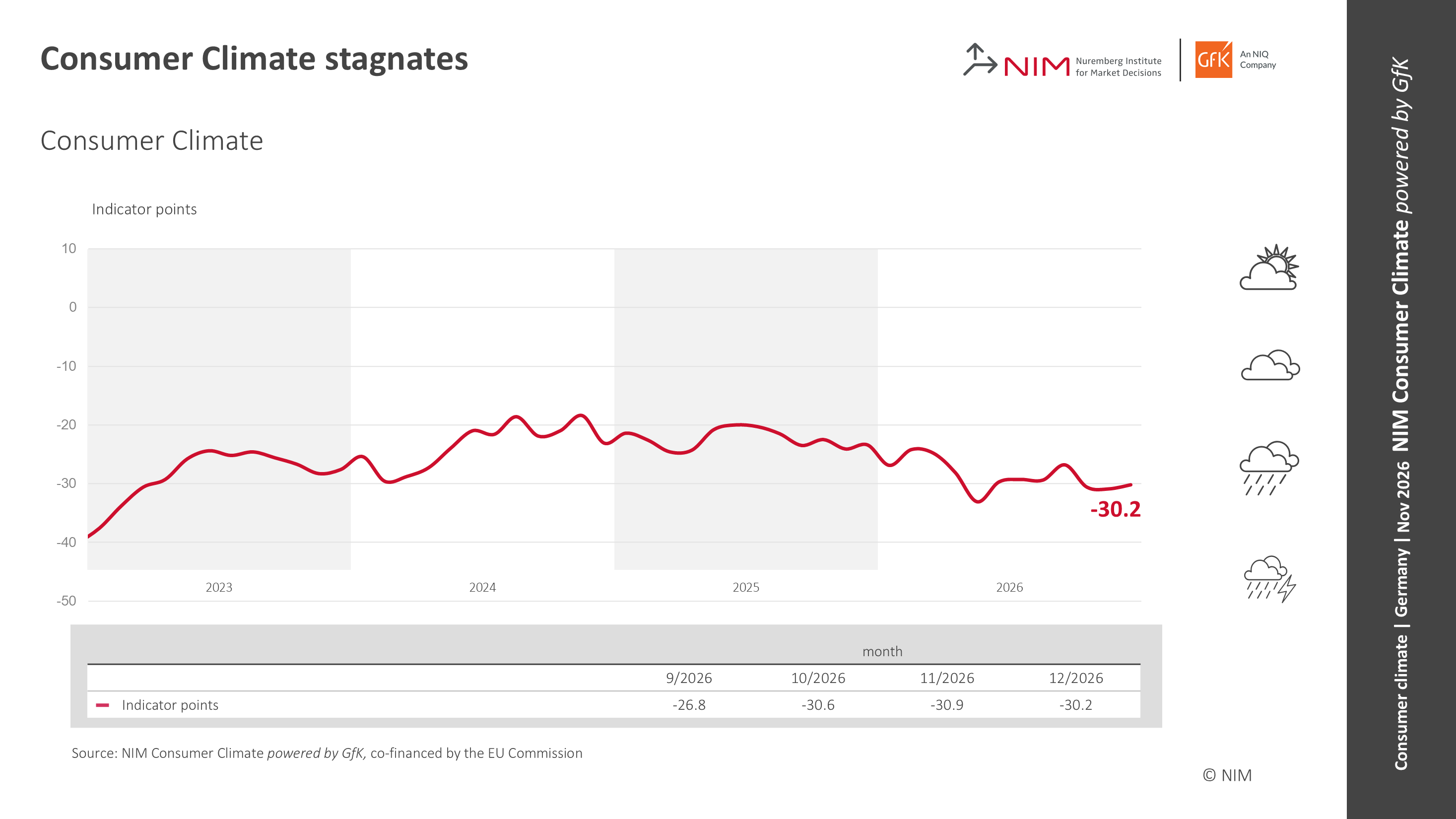
Nuremberg, November 26, 2026 – According to consumer expectations, the Consumer Climate rose by 0.7 points in December but remains at a low level of –30.2 points (revised previous month: –30.9 points), even compared to the previous year. While income expectations and the willingness to buy are increasing slightly, and the willingness to save is also leveling off somewhat, economic expectations, which had been rising for some time, are decreasing again for the first time. Concerns about inflation are also on the rise again. These are the findings of the latest NIM Consumer Climate powered by GfK.
A slight improvement, but no reversal of the trend
“Overall, consumer sentiment in November shows no major changes compared to the previous month. Consumer Climate is more or less stagnating at a low level,” explains Rolf Bürkl, Head of Consumer Climate at NIM. “This does not bode well for the upcoming Christmas shopping season. Consumer sentiment is currently even slightly lower than it was a year ago. A recent NIM study on consumers’ planned spending on Christmas gifts confirms this cautious buying mood.”
Income expectations rose slightly this month by 1.8 points, reaching –13.9 points. They had declined only slightly the previous month. Year-over-year, however, they have fallen by just under 14 points. High prices, especially for energy, continue to weigh on households and prevent a significant recovery in income prospects.
Willingness to buy remains virtually unchanged
The willingness to buy also remained virtually unchanged in November compared with the previous month. The indicator rose by 0.4 points, bringing it to –11.5 points. Compared to the same period last year, it is down by 5.5 points. Consumer sentiment thus remains stagnant at a persistently low level. This indicator, too, continues to be in the stranglehold of inflation.
Willingness to save decreases slightly again
With its second consecutive decline, the willingness to save is once again making a positive contribution to the slight improvement in Consumer Climate this month. The indicator fell by 1.6 points to 15.6 points.
Economic expectations down slightly – price expectations up slightly
After six consecutive increases in previous months, economic expectations suffered a slight setback in November. With a decline of 3.7 points, they fell to –1.6 points. This puts the indicator roughly at the same level as a year ago. Consumer price expectations are also somewhat more pessimistic this month, rising by 1.8 points to 2.8 points despite relief measures such as the fuel tax rebate.
The following table shows the values of the individual indicators in November 2026 compared to the previous month and the previous year:
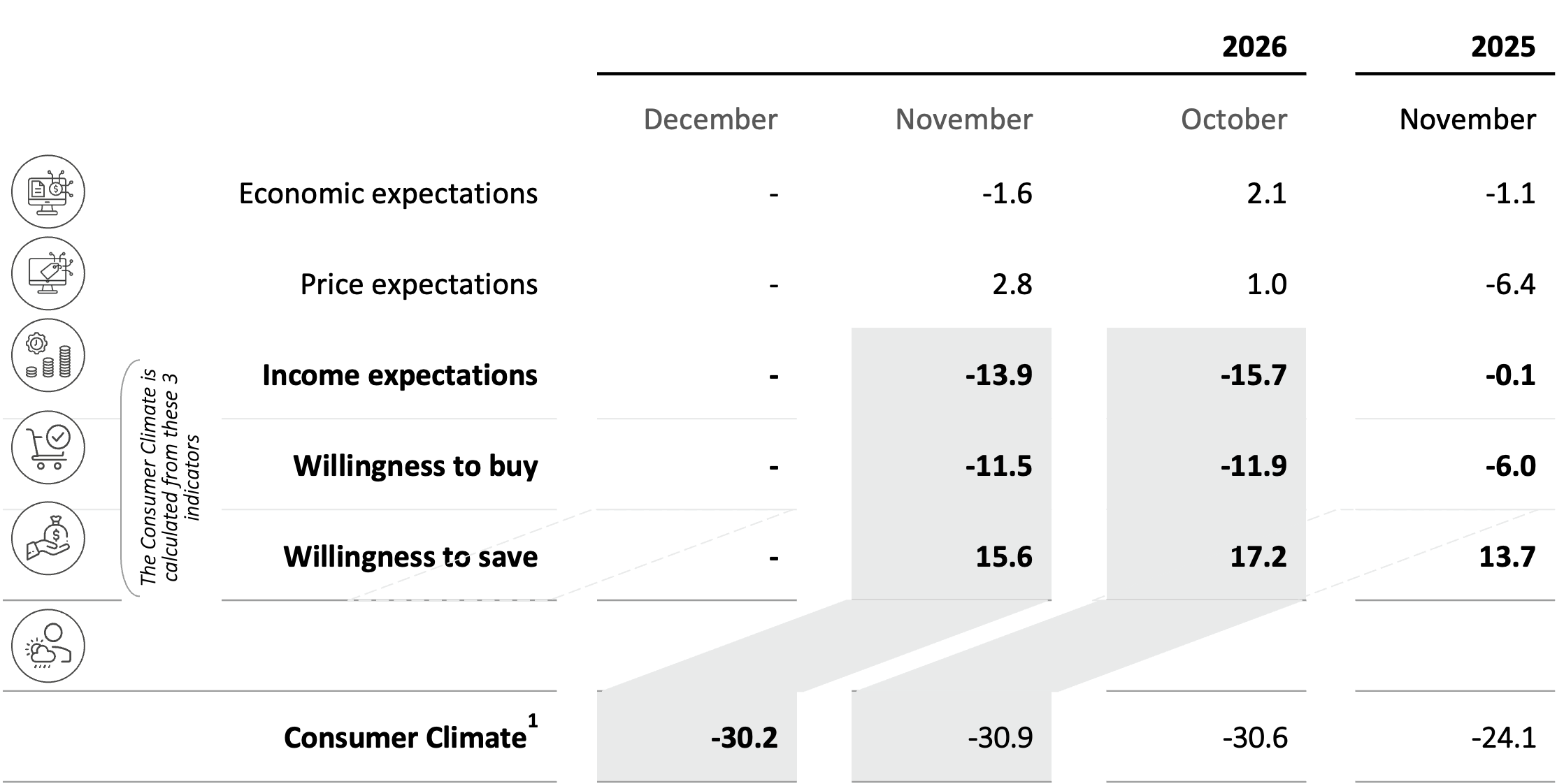
1 The consumer climate can be interpreted as a leading indicator of consumer behavior in Germany. Analyses have shown that sentiment is a leading indicator of the actual trend in private consumption. The consumer confidence index – as a leading indicator of the trend in consumption in Dezember 2026 – is calculated from the figures for income expectations, willingness to buy and willingness to save recorded in November 2026.
The following diagram shows the development of the Consumer Climate indicator over the last few years:
Planned publication dates in Q4 2026 and Q1 2027 (CET):
- Friday, December 18, 2026, 8:00 a.m.
- Thursday, January 28, 2027, 8:00 a.m.
- Thursday, February 25, 2027, 8:00 a.m.
- Wednesday, March 24, 2027, 8:00 a.m.
About the Method
The survey period for the current analysis was from October 28 to November 9, 2026. The results are extracted from the “NIM Consumer Climate powered by GfK” study and are based on around 2,000 consumer interviews conducted on behalf of the European Commission. The report presents the indicators in graphical form, accompanied by brief comments. Consumer sentiment refers explicitly to all private consumer spending. However, depending on the definition used, retail accounts for only about 35 percent of private consumer spending.
The three indicators used to calculate the consumer climate indicator:
- Income expectations: Shows how consumers rate the development of their household’s financial situation over the next 12 months.
- Willingness to save: Reflects consumers’ opinion on whether it is currently advisable to save, given the general economic situation.
- Willingness to buy: Shows the extent to which consumers consider it favorable to make major purchases (furniture, electrical/electronic appliances, etc.) given the general economic situation.
Macroeconomic indicators:
- Economic expectations: Determines consumers’ assessment of how the general economic situation in Germany will develop over the next 12 months.
- ·Price expectations: Asks how consumers believe consumer prices will develop over the next 12 months compared to the past 12 months.
Note on the indicators: These are subjective sentiment indicators, not direct behavioral data. Actual behavior (purchases, saving, income) also depends on liquidity, necessity, prices, and individual circumstances.
NIM Consumer Climate powered by GfK
The Consumer Climate survey, which is being conducted regularly since 1974 and monthly since 1980, is regarded as an important indicator of German consumer behavior and a guiding light for Germany’s economic development. Since October 2023, the Consumer Climate data collected by GfK has been analyzed and published jointly with the Nuremberg Institute for Market Decisions (NIM), the founder of GfK.
As part of a reorganization of responsibilities, starting in April 2026, the NIM took over not only the evaluation and analysis of the Consumer Climate but also all communication related to it. From this point on, the study is published under the name “NIM Consumer Climate powered by GfK” thereby returning fully to the NIM, which was responsible for the study until 1984 (then known as GfK Verein). Since June 2026, NIM has complemented its monthly reporting with the Consumer Climate Socio. Published a few days after the NIM Consumer Climate each month, it provides insights into how consumer sentiment is developing across different sociodemographic groups.
All data will continue to be collected by NIQ/GfK on behalf of the NIM. The methodology, data collection, and analysis remain unchanged.
Media Contact:
NIM: Sandra Lades, T +49 911 95151 989, sandra.lades@nim.org
NIM (Nuremberg Institute for Market Decisions)
The Nuremberg Institute for Market Decisions (NIM) is an independent, non-university-affiliated economic research institute. We examine the consumer climate and consumer behavior as a driving force of the economy. Based on academic excellence, we formulate concrete recommendations to help politics, businesses, and society make better decisions.
We finance our research with our own funds.
The Nuremberg Institute for Market Decisions is the founder of GfK.
Further information at www.nim.org/en and LinkedIn.
GfK – a NielsenIQ company
For 90 years, clients around the world have trusted us to provide data-driven answers to key questions for their decision-making processes. We support their growth through our comprehensive understanding of buying behavior and the dynamics that influence markets, brands, and media trends. In 2023, industry leaders GfK and NielsenIQ have merged to offer their clients unparalleled global reach. With a holistic view of retail and the most comprehensive consumer insights, provided by forward-looking analytics on state-of-the-art platforms, GfK is driving “Growth from Knowledge.” More information is available at www.nielseniq.com.
NielsenIQ (NYSE: NIQ) is a leading consumer intelligence company, delivering the most complete and trusted understanding of consumer buying behavior and revealing new pathways to growth. By combining an unmatched global data footprint and granular consumer and retail measurement with decades of AI modeling expertise, NIQ builds decision systems that help companies turn complex data into confident action. With operations in more than 90 countries, NIQ covers approximately 82% of the world’s population and more than $7.4 trillion in global consumer spend. Through cloud-based platforms, advanced analytics and AI-driven insights, NIQ delivers The Full View™—helping brands and retailers understand what consumers buy, why they buy it, and what to do next.
For more information, please visit www.niq.com