Press
 Download
Consumer Climate is on the rise, particularly among Gen Z and Gen X
Nuremberg, 3 September 2026 – An in-depth socio-demographic analysis of the NIM Consumer Climate powered by GfK, published last week, shows that consumer sentiment improved in September, particularly among Gen Z and Gen X. The previously published Consumer Climate indicator for September had risen by 2.8 points overall to -26.6 points. The latest analyses highlight the differences in Consumer Climate across generations.
Focus on generations
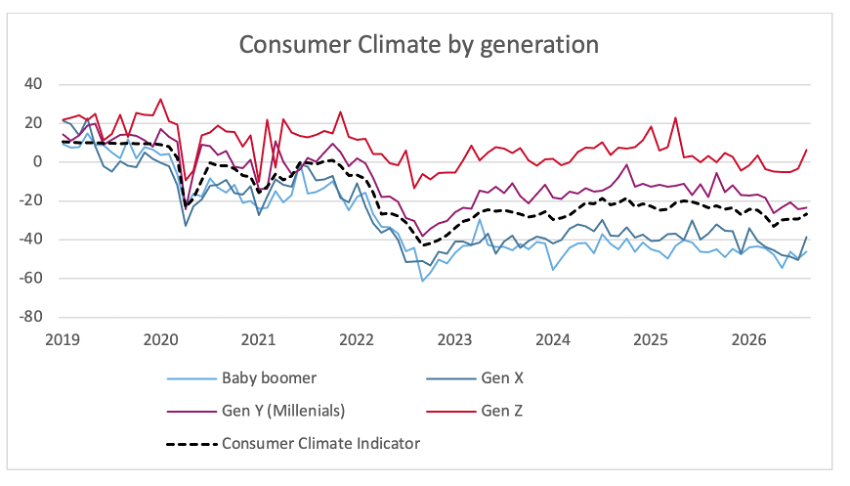
The differences between the generations had already widened during the COVID-19 crisis and became even more pronounced during the period of high inflation in 2022/23. Since then, Consumer Climate among the younger generations has been noticeably more optimistic than that of the older ones: Currently, the Consumer Climate indicator for the optimistic Gen Z (born between 1997 and 2012) stands at 6.3 points, while for the baby boomers (born between 1946 and 1964), it stands at -46.1 points. This represents a gap of 52.4 points between these generations.
Gen Z
Although Consumer Climate is improving across all generations this month, the rise is particularly pronounced among Generation Z, with an increase of 9.7 points – bringing this group’s Consumer Climate indicator slightly above the zero line. This development is driven by rising income expectations and an increased willingness to buy.
Gen X
Generation X (born between 1965 and 1980) is also showing a marked upturn in sentiment: here, the Consumer Climate indicator has risen by 11.9 points, though it remains at a pessimistic level. A declining willingness to save is the main factor contributing to this development.
Commenting on the possible reasons for these differing developments, Dr. Anja Bauer, Senior Researcher at NIM, says: “One possible explanation is the current debate surrounding reforms to healthcare, pensions and income tax. The proposed reforms affect the generations differently and are likely contributing to the diverging expectations we are currently seeing across generations.”
Trend in the Consumer Climate Indicator by generation since 2019:
The following table shows the Consumer Climate for September 2026 and the change compared with the previous month for the socio-demographic groups examined:
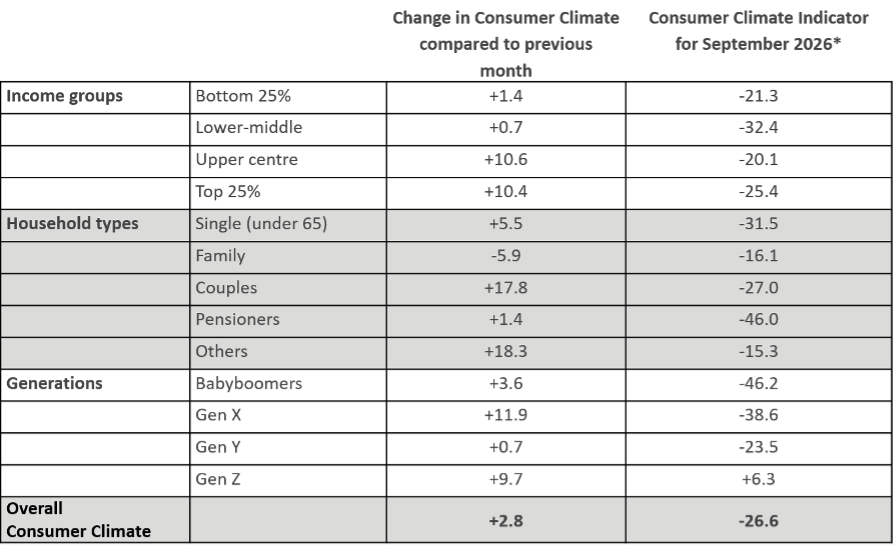
* Consumer Climate can be interpreted as a leading indicator of consumer behaviour in Germany. Analyses have shown that consumer sentiment is an early indicator of the actual trend in private consumption. The Consumer Climate indicator for the various socio-demographic groups is calculated using the determined values for income expectations, willingness to buy and willingness to save for each group.
Publication dates in Q3/Q4 2026 (CET):
- Friday, 2 October 2026, 8.00 am
- Wednesday, 4 November 2026, 8.00 am
- Thursday, 3 December 2026, 8.00 am
- Monday, 21 December 2026, 8.00 am
Methodology
The survey period for the current analysis ran from 31 July to 10 August 2026. The results are an extract from the study ‘NIM Consumer Climate powered by GfK’ and are based on around 2,000 consumer interviews conducted on behalf of the European Commission. In this report, the indicators for the socio-demographic groups are presented visually and briefly commented on. The Consumer Climate indicator refers explicitly to total private consumer expenditure. However, depending on how it is defined, the retail sector accounts for only around 35 per cent of private consumer expenditure.
The three indicators used to calculate the Consumer Climate indicator:
- Income expectations: Shows how consumers assess the development of their household’s financial situation over the next 12 months.
- Willingness to save: Reflects consumers’ views on whether, given the general economic situation, it is currently advisable to save.
- Willingness to buy: Determines the extent to which consumers consider it favourable to make major purchases (furniture, electrical/electronic appliances, etc.) in view of the general economic situation.
Socio-demographic groups:
- Generations
- Baby boomers: 1946 – 1964
- Generation X: 1965 – 1980
- Generation Y (Millennials): 1981 – 1996
- Generation Z: 1997 – 2012
- Income groups
- Bottom 25% (1st quartile) < €1,250 per person
- Lower middle (2nd quartile) €1,250 – €1,800 per person
- Upper middle (3rd quartile) €1,801 – €2,500 per person
- Top 25 percent (4th quartile) > €2,500 per person
- Household type
- Single-person household (<65 years): Household size 1 and age <65
- Family: Household size ≥ 3 & number of children ≥ 1
- Couples: Household size=2, number of children=0&age <= 65
- Pensioners: Household size >= 1 & age >= 65
- Other: Household size >= 3 & number of children = 0
Note on the indicators: These are subjective sentiment indicators, not direct behavioural data. Actual behaviour (purchases, saving, income) also depends on liquidity, necessity, prices and individual circumstances.
NIM Consumer Climate powered by GfK
The Consumer Climate, which has been surveyed regularly since 1974 and monthly since 1980, is regarded as an important indicator of consumer behaviour and as a guide to economic developments in Germany.
As part of a reorganisation of responsibilities, from April 2026 the NIM took over not only the evaluation and analysis of the consumer climate but also all communication. From this date, the survey will be published under the name ‘NIM Consumer Climate powered by GfK’, thereby returning organisationally in full to the NIM, which was already responsible for the survey until 1984 (at that time the GfK Verein).
The data will continue to be collected by NIQ/GfK on behalf of the NIM. The methodology, data collection and analysis will remain unchanged.
Press contact:
NIM: Sandra Lades, T +49 911 95151 989, sandra.lades@nim.org
Nuremberg Institute for Market Decisions e. V.
The Nuremberg Institute for Market Decisions (NIM) is an independent, non-university-based economic research institute. We examine consumer confidence and consumption as a driving force in the economy. Based on academic excellence, we formulate concrete recommendations to enable policymakers, businesses and society to make better decisions.
We fund our research from our own resources.
The Nuremberg Institute for Market Decisions is the founder of GfK.
Further information is available at www.nim.org and on LinkedIn
Sandra Lades (legally responsible for content according to the German press laws)
Head of Communication & Events
Nürnberg Institut für Marktentscheidungen e. V.
Founder of GfK
Steinstr. 21 / 90419 Nuremberg / Germany
T: +49 911 951519-89
E: sandra.lades@nim.org