Press
 Download
Consumer Climate: Significant Decrease Among Higher-Income Households
Nuremberg, 2 October 2026 – Consumer Climate is deteriorating in October, particularly among people with higher incomes. This is shown by an in-depth socio-demographic analysis of the NIM Consumer Climate powered by GfK, published last week.
Focus on income groups
The decline in Consumer Climate is particularly pronounced in the top 25 percent income group: their Consumer Climate has fallen by 13.8 points compared with the previous month to -38.0 points. By way of comparison, for Germany as a whole, the indicator for October has fallen by 3.8 points to -30.6 points.
Consumer Climate is also deteriorating in the upper-middle income group, while it remains comparatively stable in the two lower income groups. Standing at -22.4 points, the Consumer Climate of the bottom 25 percent is 15.6 points higher than that of the top 25 percent.

A closer look at income expectations, willingness to buy and willingness to save shows what lies behind the trends in the individual income groups:
Top 25 percent (4th quartile, > €2,500 net equivalent income per person)
In the top 25 percent income group, income expectations have fallen this month, the willingness to buy has dropped very significantly and the willingsness to save has increased slightly further, starting from an already high level. Overall, this results in a decrease of the Consumer Climate of 13.8 to -38.0 points.
Upper-middle income group (3rd quartile, €1,801 – €2,500 net equivalent income per person)
Following a sharp rise in the previous month, the income expectations indicator in the upper-middle income group is now falling again. The willingness to buy remains largely stable, while the willingness to save is increasing noticeably. As a result, the Consumer Climate of this group falls by 9.6 points to a level of -28.7 points.
Lower-middle income group (2nd quartile, €1,250 – €1,800 net equivalent income per person)
In the lower-middle income group, income expectations remain steady, and the willingness to buy is recovering slightly. The willingness to save has recently decreased slightly. This has led to a small increase of 3.0 points, bringing the Consumer Climate for the lower-middle income group to -28.7 points as well.
Bottom 25 percent (1st quartile, < €1,250 net equivalent income per person)
In the lowest income group, income expectations have fallen significantly, while the willingness to buy has also remained largely unchanged and the willingness to save has continued to decrease. The Consumer Climate has therefore fallen slightly by 1.0 points and stands at -22.4 points.
“Particularly striking is the contrasting trend between the willingness to buy and the willingness to save in the upper half of the income distribution: while the willingness to buy is stagnating or falling, the willingness to save is rising,” says Anja Bauer, Senior Researcher at the NIM. “This is particularly relevant for consumption, as the top half of the income distribution accounts for around 68 percent of consumer spending, while the bottom half accounts for only around 32 percent. And we are not just seeing a short-term blip here: particularly among the top 25 percent income group, we have been observing this downturn since the start of the Iran War. If higher-income households postpone major purchases and save more instead, this could noticeably slow down the recovery in consumption.”
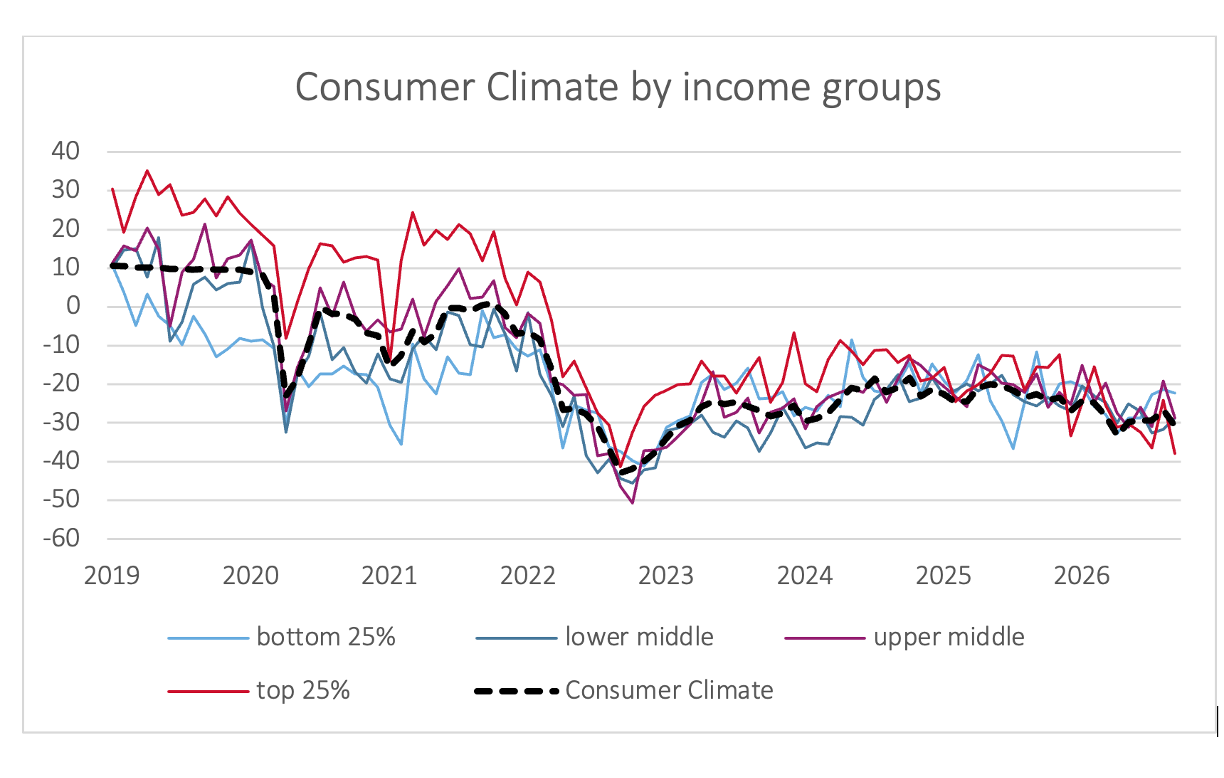
Trends in the Consumer Climate by income group since 2019:
The following table shows the Consumer Climate for October 2026 and the change compared to the previous month for the socio-demographic groups examined:
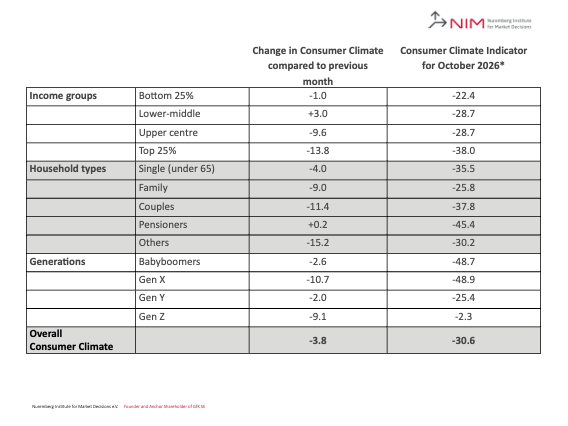
* Consumer Climate can be interpreted as a leading indicator of consumer behavior in Germany. Analyses have shown that consumer climate is an early indicator of the actual trend in private consumption. The Consumer Climate for the various socio-demographic groups is calculated using the measured values for income expectations, willingness to buy and willingness to save for each group. Further details: Bauer, A., Bürkl, R., Gangl K., & Ungemach, C. (2026). Unterschiede zwischen Alters-, Einkommens- und Haushaltstypen im Konsumklima. Mikrodaten aus Deutschland. NIM Research Report.
Planned publication dates in Q4 2026 (CET):
- Wednesday, 4 November 2026, 8:00 am
- Thursday, 3 December 2026, 8:00 am
- Monday, 21 December 2026, 8:00 am
Methodology
The survey period for the current analysis ran from 3 to 14 September 2026. The results are an extract from the study ‘NIM Consumer Climate powered by GfK’ and are based on around 2,000 consumer interviews conducted on behalf of the European Commission. In this report, the indicators for the socio-demographic groups are presented visually and briefly commented on. The Consumer Climate refers explicitly to total private consumer expenditure. However, depending on the definition used, the retail sector accounts for only around 35 percent of private consumer expenditure.
The three indicators used to calculate the Consumer Climate:
- Income expectations: Shows how consumers assess the development of their household’s financial situation over the next 12 months.
- Willingness to save: Reflects consumers’ views on whether, given the general economic situation, it is currently advisable to save.
- Willingness to buy: Determines the extent to which consumers consider it favorable to make major purchases (furniture, electrical/electronic appliances, etc.) in view of the general economic situation.
Socio-demographic groups:
- Generation
- Baby boomers: 1946 – 1964
- Generation X: 1965 – 1980
- Generation Y (Millennials): 1981 – 1996
- Generation Z: 1997 – 2012
- Income groups
- Bottom 25% (1st quartile) < €1,250 per person
- Lower middle (2nd quartile) €1,250 – €1,800 per person
- Upper middle (3rd quartile) €1,801 – €2,500 per person
- Top 25 percent (4th quartile) > €2,500 per person
- Household type
- Single-person household (<65 years): Household size 1 and age <65
- Family: Household size ≥ 3 & number of children ≥ 1
- Couples: Household size=2, number of children=0&age <= 65
- Pensioners: Household size >= 1 & age >= 65
- Other: Household size >= 3 & number of children = 0
Note on the indicators: These are subjective sentiment indicators, not direct behavioural data. Actual behaviour (purchases, saving, income) also depends on liquidity, necessity, prices and individual circumstances.
NIM Consumer Climate powered by GfK
The Consumer Climate, which has been surveyed regularly since 1974 and monthly since 1980, is regarded as an important indicator of consumer behaviour and as a guide to economic developments in Germany. Since June 2026, the NIM has supplemented its monthly reporting with the ‘Consumer Climate Socio’. This is published a few days after the NIM Consumer Climate survey and uses socio-demographic analyses to show how Consumer Climate is developing within individual population groups. Here, individual population groups are examined in more detail with regard to their Consumer Climate.
As part of a reorganization of responsibilities, from April 2026 the NIM took over not only the evaluation and analysis of the consumer climate but also all communication. From this date onwards, the publication has been issued under the name ‘NIM Consumer Climate powered by GfK’, thereby returning organisationally in full to the NIM, which had already been responsible for the study until 1984 (at that time the GfK Verein).
The data will continue to be collected by NIQ/GfK on behalf of the NIM. The methodology, data collection and analysis remain unchanged.
Press contact:
NIM: Sandra Lades, T +49 911 95151 989, sandra.lades@nim.org
Nuremberg Institute for Market Decisions e. V.
The Nuremberg Institute for Market Decisions (NIM) is an independent, non-university-based economic research institute. We examine Consumer Cliamte and consumption as a driving force in the economy. Based on academic excellence, we formulate concrete recommendations to enable policymakers, businesses and society to make better decisions.
We fund our research from our own resources.
The Nuremberg Institute for Market Decisions is the founder of GfK.
Further information is available at www.nim.org and on LinkedIn
Sandra Lades (legally responsible for content according to the German press laws)
Head of Communication & Events
Nürnberg Institut für Marktentscheidungen e. V.
Founder of GfK
Steinstr. 21 / 90419 Nuremberg / Germany
T: +49 911 951519-89
E: sandra.lades@nim.org
[AB1]Copy from last time.