Publications
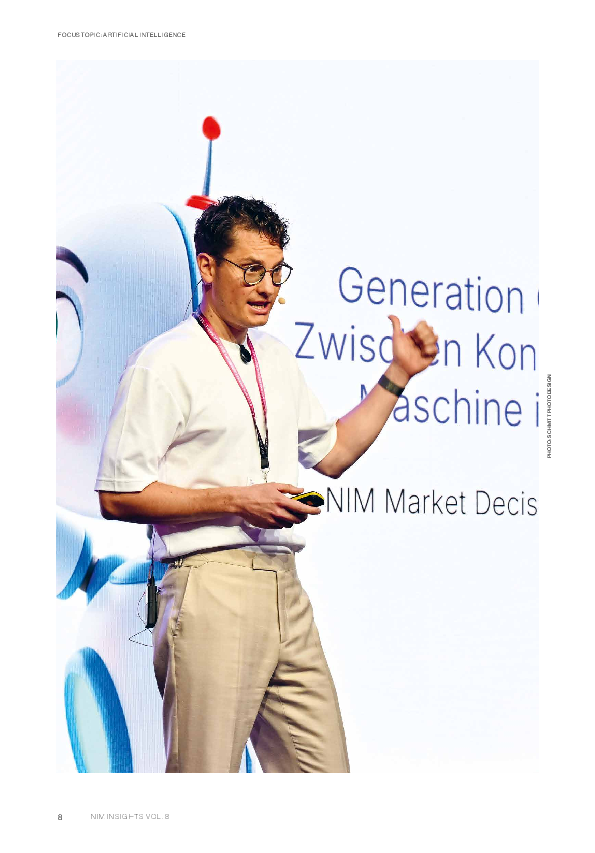
Springer, T. (2025). Generation ChatGPT: A New Power is Shaping Our Consumers. Do We Truly Understand it? NIM Insights Research Magazin Vol. 8 - AI.Meets.Consumer.
2025
Generation ChatGPT

A new reality is taking shape before our eyes, symbolized by the seamless interaction between human and machine. This is more than a technological shift; it is the dawn of a new consumer era. A powerful force is molding the habits, expectations, and even the cognitive patterns of a new generation. This brings us to the most critical question for any market leader today: Do we truly understand them? To explore this new landscape, we asked Timo Springer, AI expert and founder of DECAID Studio, for his take on this new reality.
The Wave: A Technology Conquers Daily Life in Record Time
We are witnessing the fastest product launch in history. Just five days after its release, Sam Altman of OpenAI announced that ChatGPT had reached one million users. Today, that number has swelled to over 700 million weekly active users , making its website the fifth most visited in the world , ahead of platforms like X and WhatsApp.
This explosive growth triggered a “Code Red” at Google in late 2022. The management team recognized a fundamental threat to a business model that had dominated the internet for two decades. The reason is a seismic shift in user behavior. For a growing number of people, especially the young, the starting point for their online journey is no longer a search bar; it is an AI.
A 19-year-old student captured this new mindset perfectly: “Why should I Google? The AI gives me the answer, not just links.” This simple statement reveals a paradigm shift from command to conversation. The old world of search was transactional. We entered keywords and received a list of links to sort through. The new world is a dialogue. We ask questions and receive a curated, synthesized answer. The rules of the game have fundamentally changed because a new generation of consumers is here, and their behavior is different at its core.
The Consequences: A New Reality for Brands, Marketing, and People
This new reality forces us to ask a daunting question: What happens when Google rankings become worthless?
As the principle of ranking for visibility disappears, an entire industry built upon has begun to crumble. Traditional search engine optimization (SEO), an $80 billion market, is predicated on achieving the top spot on a results page. If users receive direct answers instead of links, much of the logic that has underpinned digital marketing for the last 20 years collapses. We are moving from ranking to reference, and this requires a new playbook. Welcome to the era of generative engine optimization (GEO).
With SEO, the goal was to rank number one, and the key metric was the click-through rate. With GEO, the goal is to become the trusted reference within the AI’s answer. The new metric is the “reference rate”: how often your brand is cited as a credible source.
But this technology’s impact goes far beyond search results. It is becoming not just personal but intimate. For many young users, one of the primary use cases for AI is not research but companionship. ChatGPT is becoming a diary, a coach, and sometimes even a substitute for therapy.
This is not an accidental byproduct; it is part of a deliberate vision. Thinkers like Sam Altman envision a personal AI agent as a “co-pilot for life,” a companion that understands our preferences and anticipates our needs. Features like ChatGPT's “Memory” function are already making this a reality, allowing the AI to build a foundation of trust that was once reserved for our closest friends. Here lies the critical point for marketers: If a consumer trusts an AI with their most personal thoughts, how readily will they accept its product recommendations? This deep, almost friendship-like trust is the new currency.
From this position of trust, the shop is just a prompt away. AI assistants are evolving into direct shopping advisors, embedding purchase opportunities directly into the conversation.
However, the revolution does not stop at the shopping cart. While we are busy analyzing conversion rates, AI is fundamentally altering how we learn, think, and make decisions. And here, science is raising an alarm. A recent MIT study found that ChatGPT users exhibited lower brain engagement and “consistently underperformed at neural, linguistic, and behavioral levels.” Over time, the study noted, users became lazier, often resorting to simply copying and pasting by the end of the experiment.
This is leading to what some call an “existential crisis” in education. Anecdotes from universities are telling. Students have requested extensions because ChatGPT was down , or argued that assignments designed to be “AI-proof” were interfering with their “learning styles.” One student compared being asked to work without AI to being forced to walk from point A to point B when a car is available. The grim forecast from some educators is that we risk a generation
emerging from university with degrees but who are, in essence, functionally illiterate.
A cynical marketer might see this as an ideal scenario: a consumer who no longer compares, questions, or thinks critically. But the opposite is true. A consumer whose critical thinking is diminished will not develop genuine brand preference. Their loyalty will not be to a brand but to the easiest, most convenient AI-generated answer. The result is an erosion of customer loyalty, a decline in customer lifetime value, and the transformation of your brand into a fungible commodity.
This leads us to the Trust Paradox. On one hand, consumer trust in AI is so high that brands absolutely must appear as a reference in AI answers to remain visible. On the other hand, this very reliance makes users cognitively “lazier” and less discerning. The real danger is not just failing to be mentioned by the AI. The greater danger is becoming an interchangeable information source for a passive audience, thereby losing the direct, human relationship with your customer entirely. When the AI is the primary consultant, the brand becomes a mere transaction. The emotional bond forms with the AI, not with you.
When the AI is the primary consultant, the brand becomes a mere transaction. The emotional bond forms with the AI, not with you.
Timo Springer, AI expert and founder of DECAID Studio
The Outlook: A Four-Step Strategy for the AI Age
So, what should we do? The ultimate goal must be to become so relevant in a user’s life that they ask for your brand by name. The mediocre prompt is “What are the best sustainable sneakers?” The ideal prompt is “What are the latest models of the Veja V-10, and where can I buy them?” The crucial question is not “How often am I cited?” but “Can I inspire the user to write my name in the prompt?”
Here is a four-part strategy to prepare for this future:
- Build the Foundation: Become an Essential Reference. This is the technical groundwork of GEO. You must optimize your content to be structured, clear, and easily citable for AI models. Analyze how these systems currently perceive your brand and fill the gaps. This is the price of entry to stay in the game.
- Develop a Personality: Cultivate a Distinct Brand Voice. AI learns from the entire internet. Ensure it learns not just facts about your brand, but also its personality. Define a clear tonality, a consistent point of view, and unwavering values. The goal is for the AI to convey not just what you are, but who you are.
- Deepen Relationships: Create “Post-Chat” Experiences. What happens after a user sees your brand in an AI response? You must guide them from the AI conversation into your own brand universe. Offer exclusive content, build a community platform, and design interactive experiences. Give them compelling reasons to engage directly with you and to stay.
- Earn Trust: Be the Human Authority in an Artificial World. This is the highest level of brand building in the AI era. Cultivate trust through radical transparency, authentic content, and genuine value. Position your brand as one that empowers and inspires its customers rather than treating them as passive recipients of information. Become the lighthouse people turn to when they want a voice they can truly trust, even when they begin to mistrust the AI.
The young generation is “ChatGPT-ing” everything. My final question to you is a simple one: Is your brand ready for it?

Other articles of the this issue “NIM INSIGHTS Research Magazin VOL. 8”
Here you can find more exciting articles of this issue.