Publications
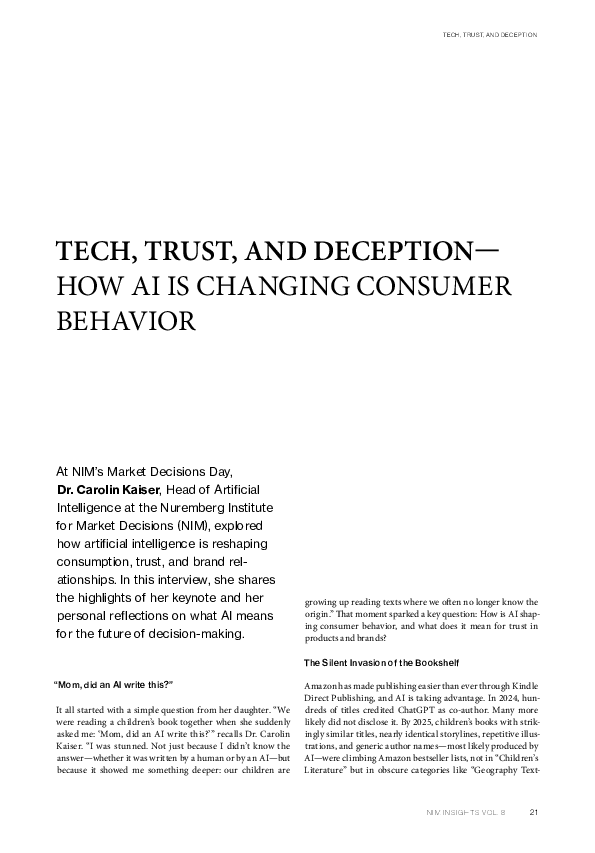
Kaiser, C. (2025). Tech, Trust, and Deception. How AI is Changing Consumer Behavior. NIM Insights Research Magazin Vol. 8 - AI.Meets.Consumer.
2025
Tech, Trust, and Deception
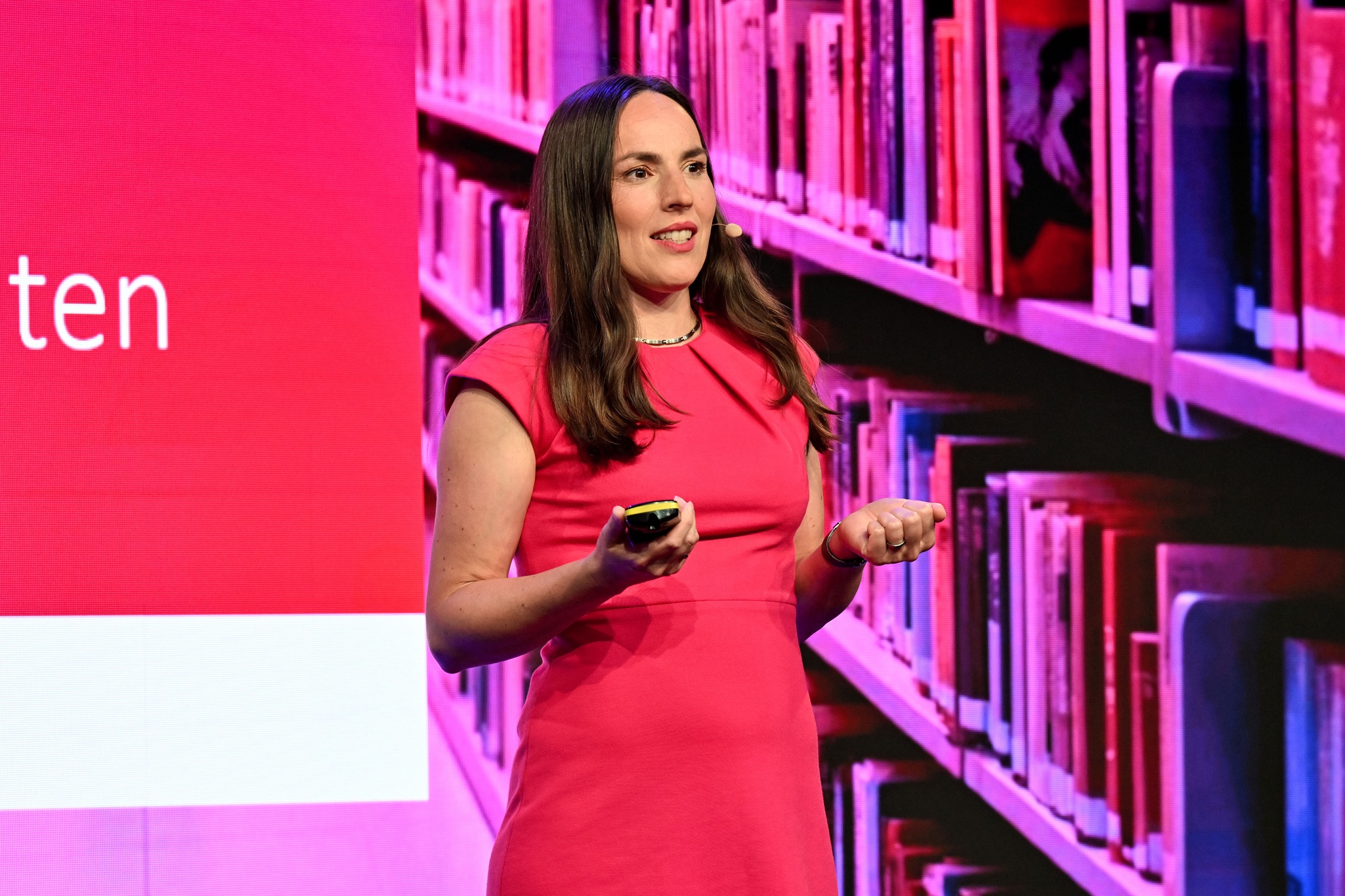
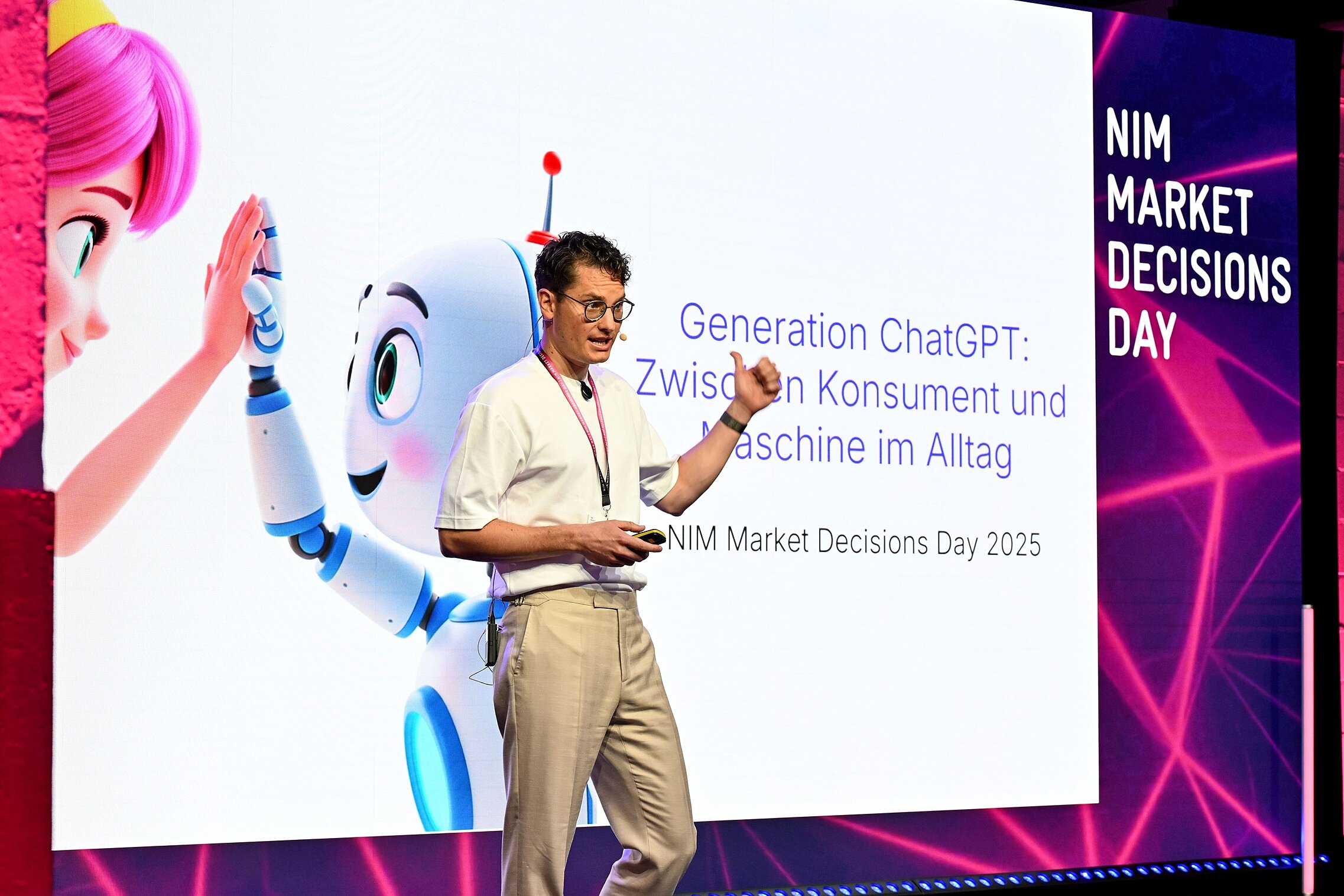
At NIM’s Market Decisions Day, Dr. Carolin Kaiser, Head of Artificial Intelligence at the Nuremberg Institute for Market Decisions (NIM), explored how artificial intelligence is reshaping consumption, trust, and brand relationships. In this interview, she shares the highlights of her keynote and her personal reflections on what AI means for the future of decision-making.
“Mom, did an AI write this?”
It all started with a simple question from her daughter. “We were reading a children’s book together when she suddenly asked me: ‘Mom, did an AI write this?’” recalls Dr. Carolin Kaiser. “I was stunned. Not just because I didn’t know the answer—whether it was written by a human or by an AI—but because it showed me something deeper: our children are growing up reading texts where we often no longer know the origin.” That moment sparked a key question: How is AI shaping consumer behavior, and what does it mean for trust in products and brands?
The Silent Invasion of the Bookshelf
Amazon has made publishing easier than ever through Kindle Direct Publishing, and AI is taking advantage. In 2024, hundreds of titles credited ChatGPT as co-author. Many more likely did not disclose it. By 2025, children’s books with strikingly similar titles, nearly identical storylines, repetitive illustrations, and generic author names—most likely produced by AI—were climbing Amazon bestseller lists, not in “Children’s Literature” but in obscure categories like “Geography Textbooks,” where competition is low. “It was a clever placement strategy, but with highly questionable quality,” explains Dr. Kaiser. “And the most surprising part: there is still no obligation to label such content as AI-generated.”
Humans Preferred
In an online experiment with 1,100 U.S. participants, NIM researchers compared reactions to human- versus AI-authored books. The results were clear: consumers valued human work more highly. Their willingness to read and to pay dropped significantly when a book was attributed to AI. The reasons? “People see human creativity as more effortful. And they miss the emotional connection when they know something was created by a machine,” Dr. Kaiser explains. The same pattern emerges in studies on advertising, music, art, and even perfume.
From Search Engine to Answer Engine
Despite skepticism about AI-generated creativity, consumers increasingly rely on AI as a shopping advisor. In a study with 1,500 U.S. participants, one group used Google to complete shopping tasks while another used ChatGPT. “The ChatGPT group reached better product decisions faster,” Dr. Kaiser notes. “But only 12% bothered to check other websites, compared to 73% in the Google group. People said: ‘I feel like ChatGPT is thinking for me.’ That’s powerful—but also risky.”
Sponsored Advice
The risk grows once money enters the picture. Perplexity already experiments with sponsored answers. NIM explored how disclosures shape trust. In a classic touch interface, consumers lost trust once sponsorship was revealed. But in conversational settings, trust remained stable even when recommendations were paid. “The more immersive the interaction, the less people notice advertising cues,” Dr. Kaiser explains. “That’s a huge opportunity for companies—but also a risk for consumers.”
What Comes Next
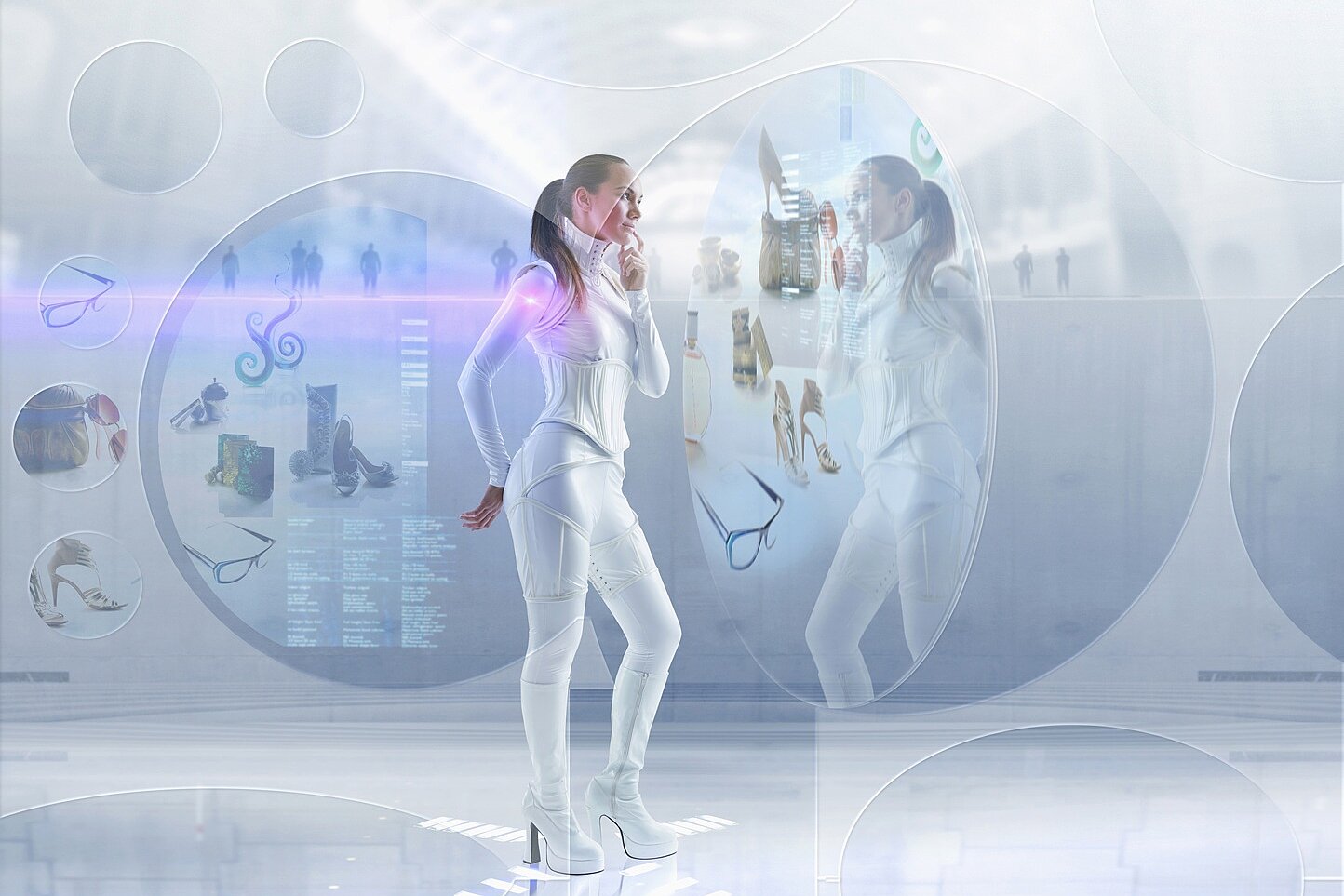
AI-driven commerce is moving fast. In the U.S., Google’s “Shop with AI” feature already delivers conversational product recommendations, complete with images and purchase links. With “Visual Try-On,” consumers can test clothing virtually using their own photos. For brands, this means a shift from SEO to AEO, Answer Engine Optimization. Authentic, in-depth content will matter more than keyword tricks. For consumers, it means more convenience but also more responsibility. And the next step is agentic commerce: AI agents that autonomously search, compare, and purchase on behalf of consumers. Google, Visa, Mastercard, and Perplexity are already preparing for it.
A Personal Reflection
Dr. Carolin Kaiser closes her reflections with another story from home. “We were reading a book about courage. At the end, my younger daughter hugged her stuffed elephant and whispered: ‘Don’t be afraid, little elephant. You are a brave elephant.’” That moment made her pause. “Maybe the book was written by a human. Maybe by an AI. But ultimately, that doesn’t matter. What matters is the emotion it sparked, the connection it created.” Her takeaway: “We cannot stop the machines. But we can decide who we listen to—and who we trust.”
![[Translate to English:]](/fileadmin/_processed_/1/2/csm_CK_NIM_01_6f344242bf.png "[Translate to English:]")
Other articles of the this issue “NIM INSIGHTS Research Magazin VOL. 8”
Here you can find more exciting articles of this issue.