Haenlein, M. (2026). To Boldly Go Where No Research Has Gone Before: AI in Marketing Intelligence. NIM Marketing Intelligence Review, 18(1), 10-17. https://doi.org/10.2478/nimmir-2026-0002
To Boldly Go Where No Research Has Gone Before: AI in Marketing Intelligence
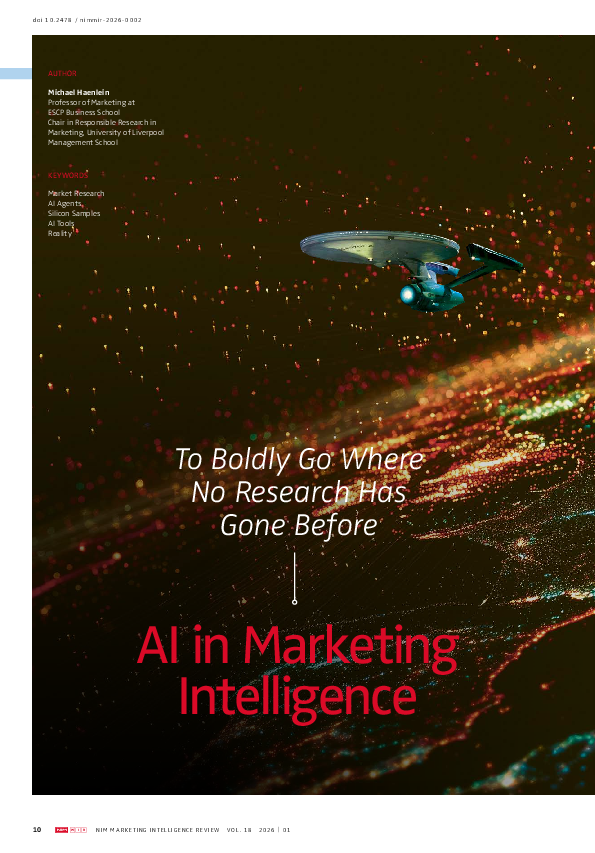
If you are older, you may remember the starship USS Enterprise, the original starship of the early Star Trek universe, with its famous Captain Kirk, whose mission was to explore the unknown regions of space, chart new frontiers and expand scientific understanding. In every episode, the Enterprise entered a whole new world, similar in parts to life on Earth, but sufficiently different to create new challenges and opportunities. Today, marketing research also enters a whole new world due to the emergence of generative artificial intelligence (AI). ChatGPT, one of the most well-known tools in this space, was launched commercially only in November 2022, yet it has transformed our world, much like a three-year-old child entering a family. The following briefly outlines what AI can already do, what it is likely to achieve soon and which new questions arise from this evolution.
Charting the known universe: today’s capabilities and what’s already visible on the horizon
Today, AI already has an impact – sometimes small, sometimes substantial – on every step of the market research process. While some of these effects are subtle, other innovations pave the way for deeper shifts. The next section briefly outlines what is already possible and what is likely to emerge over the next 12–24 months. Figure 1 provides an overview of these AI capabilities in market research and the benefits they offer. The solutions mentioned are already available or under active development by numerous companies and startups.

> AI-inspired research questions
While formally it will still be the marketing manager or researcher who decides where to spend their money, these decisions no longer need to rely solely on experience, gut feeling or input from others. Today, AI tools can automatically derive research questions from CRM systems or social media platforms and, once they receive a “green light,” draft research briefs that include objectives and hypotheses. Compare this to the evolution of self-driving cars, which increasingly take over the mundane tasks of cruising within the speed limit on a highway. In the future, similar to self-driving cars, these tools will evolve into autonomous research planning agents that increasingly autonomously decide what research is needed – and what is not – based on KPIs and business objectives. This will result in an “always on” system that continuously identifies problems, selects appropriate methods, estimates sample sizes and simulates trade-offs among time, cost and accuracy to optimize the return on investment in marketing research.
> AI-optimized samples
Any research is only as good as the data on which it is based. This rule remains with or without AI. Already today, AI can help with fraud or bot detection, an increasingly significant issue within online panels. It can also assist in imputing missing respondents or weighting existing ones to compensate for the growing problem of non-response bias in empirical research. In the future, asking real people will increasingly be combined with silicon sampling. These are synthetic agents, calibrated on a combination of prior survey responses, purchasing data and population-level statistics, that serve as digital twins of existing consumers. While silicon samples will likely never replace insights derived from actual humans, they are increasingly used in combination to form hybrid samples. And those who see this idea as sketchy may want to reconsider. Data quality from online panels is declining, often because real people pretend to fit whatever demographic is required. At the same time, the quality of synthetic data is rising. These trade-offs are likely to become far less obvious in the near future.
> AI-supported survey guide creation
Creating the actual survey guides has always been one of the more tedious parts of empirical marketing research. Much of this work can now be automated: selecting the correct measurement scales for complex constructs, formulating qualitative questions with minimal implicit bias, and implementing advanced filtering and quota rules. The same applies to checking that a survey functions properly, so respondents – who are often hard to recruit – don’t run into a dead end after they begin. AI can write surveys and discussion guides and develop hyperrealistic stimuli for ads or concepts. With one click, AI can not only translate survey guides into the local language but also address more nuanced cultural differences in the process. Very soon, AI will be used to make surveys more dynamic, with stimulus creation that reacts in real time to prior respondent input. Surveys or interview guides will update in real time based on what the respondent has said and what others have said before them, opening hitherto unknown opportunities for testing and data collection.
> Agentic interviewers and silicon samples
Marketing research is costly, and often the lion’s share of these costs comes from data collection. In an era where humans are increasingly reluctant to answer surveys – if they can be reached at all – this issue is more pressing than ever. Long gone are the days when random-digit dialing of phone numbers actually yielded a random sample of people. AI can help in two ways: First, studies using simulated agents can refine the ideal participant pool more effectively and identify failure-prone issues and questions. Today, it is already possible to simulate qualitative interviews and conduct “virtual focus groups” entirely using AI. While these techniques will likely never replace human interaction, they can make the preparation process more efficient and effective. Think of silicon samples and AI agents more as pretesting on steroids than as a potential replacement for traditional data collection techniques. Second, once humans are targeted, AI can make interviews more engaging. In qualitative research, hard-to-reach audiences can interact with an AI agent available 24/7 in their preferred language. Statistical models can analyze facial microexpressions and screen behavior in real time, use the information to correct for potential bias (such as social desirability), and even adapt surveys to reduce or even avoid dropouts.
> Enhanced data analysis
Analysis, be it of quantitative or qualitative data, is as much an art as it is a science. While AI may not be able to take over artistic aspects, it can certainly assist with scientific ones. AI tools can automatically code open-ended questions, provide instant summaries of emerging themes, suggest the right method to analyze your data, correct for biases and, if you are unfamiliar, teach you those methods and provide the code to run them. Soon, the same tools will be able to combine insights from fresh data with existing knowledge available in CRM systems and satisfaction surveys to identify anomalies, help triangulate results and test for sampling biases. While all of this cannot eliminate analysis mistakes or misleading insights, it can significantly reduce their risk – and the resulting embarrassment when presenting them to your manager or client.
> Customized reporting and recommendations
Let’s face it: We, as marketing researchers, are sometimes not very good at getting our insights across. Some of the blame may be on us: Let him who has never been criticized for adding too much detail or including one table too many be the first to throw a stone! Still, often the problem is that one report must serve the objectives of multiple stakeholders, with varying interests and degrees of prior knowledge. With AI, this will become a problem of the past. Reports can be presented in various formats: from slide decks to podcasts, videos and interactive chatbots. Plus, they can be personalized for each stakeholder, taking into account their interests and decision-making scope. Eventually, findings can be used to simulate the outcome of alternative decisions in a way that is more user-friendly and more accurate than what we know today. Marketing research has often been criticized for spending money on generating insights that end up in a drawer and are never put into action. This issue will likely become a thing of the past.
When insights are partly or fully derived from simulated agents and silicon samples, what does truth even mean?
Entering uncharted space: the questions that will define the next era
If you feel excited about all these possibilities – welcome to the club. AI is exciting. However, it is also a disruptive innovation that not only shapes how things are done but raises entirely new questions we cannot answer yet. While these questions may not require an immediate answer, they are fundamental issues that must be considered moving forward.
> The unstable core: What counts as truth when reality becomes a simulation?
As humans, we tend to assume that technology-mediated processes follow the same rules as human ones. In reality, this is unlikely to be accurate, as discussed in Box 1 regarding word of mouth. When insights are partly or fully derived from simulated agents and silicon samples, what does truth even mean? Will we enter an echo chamber in which the opinions of the few who respond to our surveys and participate in our interviews are amplified and become widely accepted marketplace beliefs? What happens if we remove from the data all the noise that comes with lived experience? Will we lose crucial contextual richness? What do basic concepts like validity even mean in this brave new world? Are simulated responses valid if they mirror what humans would report? Are they valid if they predict human behavior? A lot has been said about fake news, but is simulated truth maybe more fake than real truth?

> Shadows in the system: bias, drift and the fragility of AI-derived insights
The butterfly effect is a well-known concept in chaos theory, which states that small variations in complex systems can amplify into substantial effects. Similar problems can occur in silicon samples. Even if sources are unbiased at the start, model weights will shift over time, leading to silent drift and patterns that become increasingly less accurate, whatever “accuracy” may mean. Matters become substantially worse if the input data is already biased, as AI systems trained to detect subtle patterns are prone to amplifying them. Already today, concerns are being raised that most conventional AI tools are primarily trained on data from English-speaking and Western societies. AI tools, regardless of which ones are used, are, by their very nature, black box algorithms. Will managers be comfortable making decisions based on insights that are fully or partly derived from systems they cannot understand?
> A new balance of power: Who commands insights in an autonomous research galaxy?
In many ways, AI will make market research easier and faster. On the flip side, this also means that marketing managers will believe – rightly or wrongly – that they no longer need to rely on specialized research teams to set up or even conduct basic research. In the process, traditional research teams will lose control over scoping, design and interpretation. In such a world of decentralized and fragmented research, who is in charge? Who curates the insights narrative and ensures research meets minimum quality requirements? How do these changes influence the structure of jobs and tasks with marketing research teams? Which new jobs will emerge: data engineers, prompt specialists, model supervisors or simulation designers? Will analysts and project managers no longer be needed? Can the latter functions be retrained to conduct the former? Or are the required skill sets different, resulting in significant shifts in workforce composition?
> The race for distinction: How can businesses build advantage in a universe of identical tools?
AI will not only change how marketing research is conducted and organized within companies, but also how competitive advantage is shaped across industries. Realistically, most organizations will not develop proprietary AI tools. The necessary investment would be enormous and not aligned with their core business. In a world where everyone uses the same tools, three ways to differentiation still exist: First, input data will be crucial, and differentiation will shift to proprietary first-party data. Those companies that already have access to unique data, through a well-designed CRM system or prior marketing research efforts, will have a clear head start. Second, model tuning will matter. All use the same baseline models, but how these models are tuned and prompted can lead to subtle differences that likely amplify in effect over time. And finally, speed will matter. Those companies that spot new research opportunities quickly, implement them and act on them fast will literally win the race. All of this is easier said than done. It requires organizational agility and trust in AI systems and their insights, despite their black-box nature.
> From observation to adaptation: Where is the next frontier of customer understanding?
Taking a broader perspective, AI will transform marketing research from a function focused on retrospective analysis to one dealing with prospective simulation. Companies will increasingly maintain databases of digital twins that represent their consumer base and the market as a whole, continuously refining them with new data to predict unobserved behavior. These predictions will then be used to shape future decisions, like which new products to introduce. In the process, consumer understanding will become continuous, no longer considered a project with a fixed start and end date. A key challenge will be to see the forest for the trees and to cut through the undergrowth of simulated research. If everyone can conduct surveys independently and affordably, how can we manage the vast amount of new and possibly flawed knowledge and determine what is actually needed? In the end, the meaning of insights will probably shift from discovering patterns (and reporting them) to training systems that the organization uses as a basis for decision-making.
> Sentient systems: rethinking the purpose of research in an autonomous era
The big question is: What happens to research and traditional research values when AI agents autonomously decide what to study, design the study, conduct it, interpret the results and simulate decisions? Do factors like representativeness and fieldwork rigor even have meaning? Will what we consider “good research” today soon become an anachronism, like a handmade suit in a world of fast fashion? One way to view this is that traditional marketing research will be divided into two segments. One part will focus on optimizing outcomes. This is the world of 80/20 research, where studies are conducted in a decentralized manner using silicon samples to generate directional insights that inform better decisions. Many of these studies would likely never have been conducted in the pre-AI era, as the decision was not sufficiently important or the timeline was too short to justify the effort. So not much is lost, and potentially a lot is gained. The other part will be a function focused on human understanding, in which actual humans design studies – most likely with the help of AI – that collect data from other humans. Those studies may be more expensive (like handmade clothes) and limited to the big strategic questions.
Human judgement will be the guard who guards the guardians and prevents the rise of unchecked automation.
A new orbit: Human judgment in AI research systems will remain key
As marketing researchers, we have seen many changes. Our world of paper-and-pencil surveys conducted over fixed-line phones or door-to-door has slowly been replaced by mobile surveys distributed via online panels. However, AI is likely to be a different ballgame. It not only makes traditional processes more efficient but also opens up a whole new world of possibilities. Even if the new orbit raises more questions than answers now, one principle seems clear: In this new world, human judgment will remain key, at the center of the “big projects,” where understanding is crucial and a black-box approach will not suffice. It will serve as the safeguard that prevents model drift and the emergence of an echo chamber of fake news. And it will be the guard who guards the guardians and prevents the rise of unchecked automation. In Star Trek, the starship Enterprise relied on its autopilot when navigating the vast emptiness of space. But in important moments, James T. Kirk had to take the controls himself. The future of AI-enhanced marketing research will be similar. AI will assist us with routine tasks, but in moments that truly matter, human judgment must steer the ship. As long as we keep that balance, the discipline is in safe hands.
Haenlein, M. (2026). To Boldly Go Where No Research Has Gone Before: AI in Marketing Intelligence. NIM Marketing Intelligence Review, 18(1), 10-17. https://doi.org/10.2478/nimmir-2026-0002
Other articles of the MIR issue “AI in Market Research”
Here you can find more exciting articles of this issue.