Hewett, K. & Yoo, K. (2026). A New Frontier of Understanding: Where Generative AI Adds Real Value in Consumer Research. NIM Marketing Intelligence Review, 18(1), 17-23. https://doi.org/10.2478/nimmir-2026-0003
A New Frontier of Understanding: Where Generative AI Adds Real Value in Consumer Research
Today’s marketing managers are under intense pressure to deliver consumer insights faster, at lower cost and without compromising quality. Traditional tools such as surveys, focus groups and in-depth interviews have powered decades of successful brands. But they can be slow, expensive and limited by what consumers are willing or able to articulate. Enter generative artificial intelligence (GenAI). Hailed as a transformative tool, it promises speed, efficiency and creativity. But where does GenAI truly add value in consumer research, and where does it fall short? We provide answers by walking through the consumer research process stage by stage.
Consumer research in the age of GenAI: not a magic wand, but a smart partner
GenAI, particularly large multimodal models (LMMs) such as ChatGPT or Gemini, can be plugged into almost every step of the research process. However, not all uses deliver equal value. Done right, GenAI will not replace your team, but it will release them to focus on higher-value work. Done wrong, it can waste time or even erode credibility. The key is knowing where GenAI consistently helps and where human expertise must lead. Evidence from recent research testing GenAI’s effectiveness in the consumer research process shows a consistent pattern. Specifically, LMMs are strongest in idea generation, theory development, pretesting and pilot testing, collecting data, and reporting. On the other hand, GenAI is least reliable for simulating human behavior/attitudes with silicon samples and synthetic datasets and in advanced data analysis.
Applying GenAI across the consumer research process
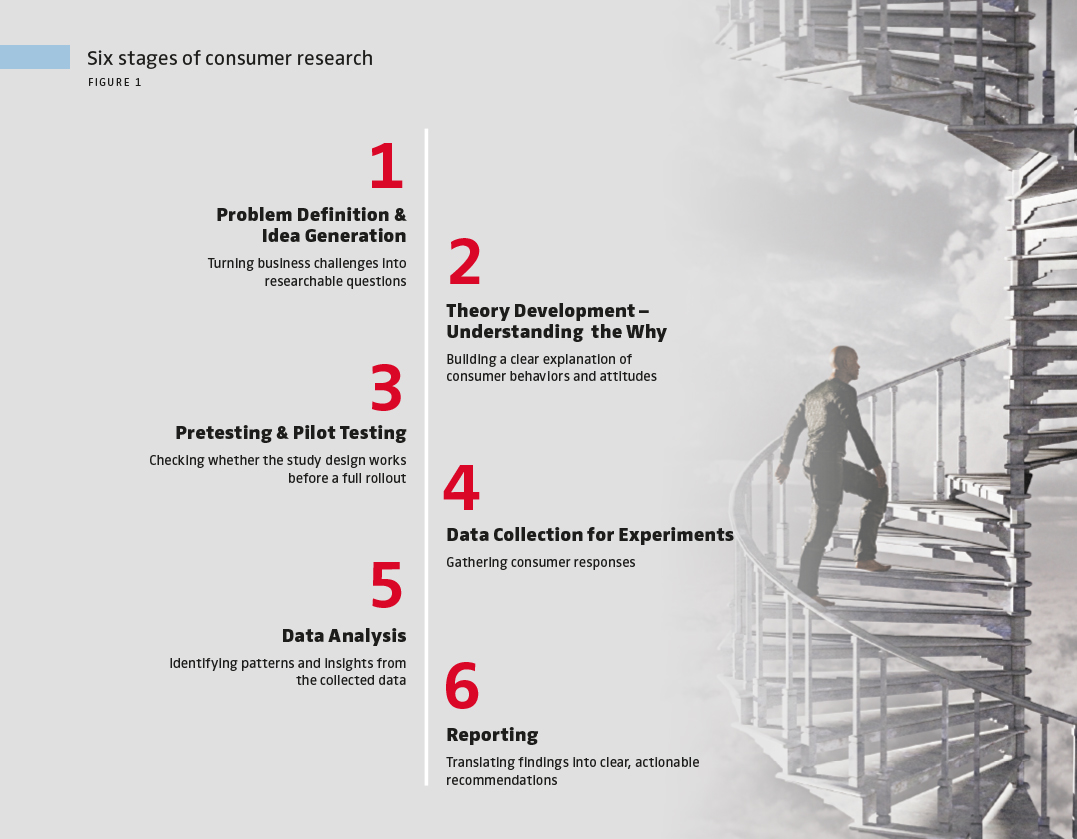
Consumer research follows a repeatable cycle from defining the problem to reporting results. Figure 1 describes the six common stages of the consumer research process. By walking through each stage, we can pinpoint what GenAI does well and where human judgment must lead. The goal of incorporating GenAI is not to replace researchers, but to free them for higher-value thinking while GenAI handles breadth, iteration and clarity.
Stage 1: Problem definition & idea generation
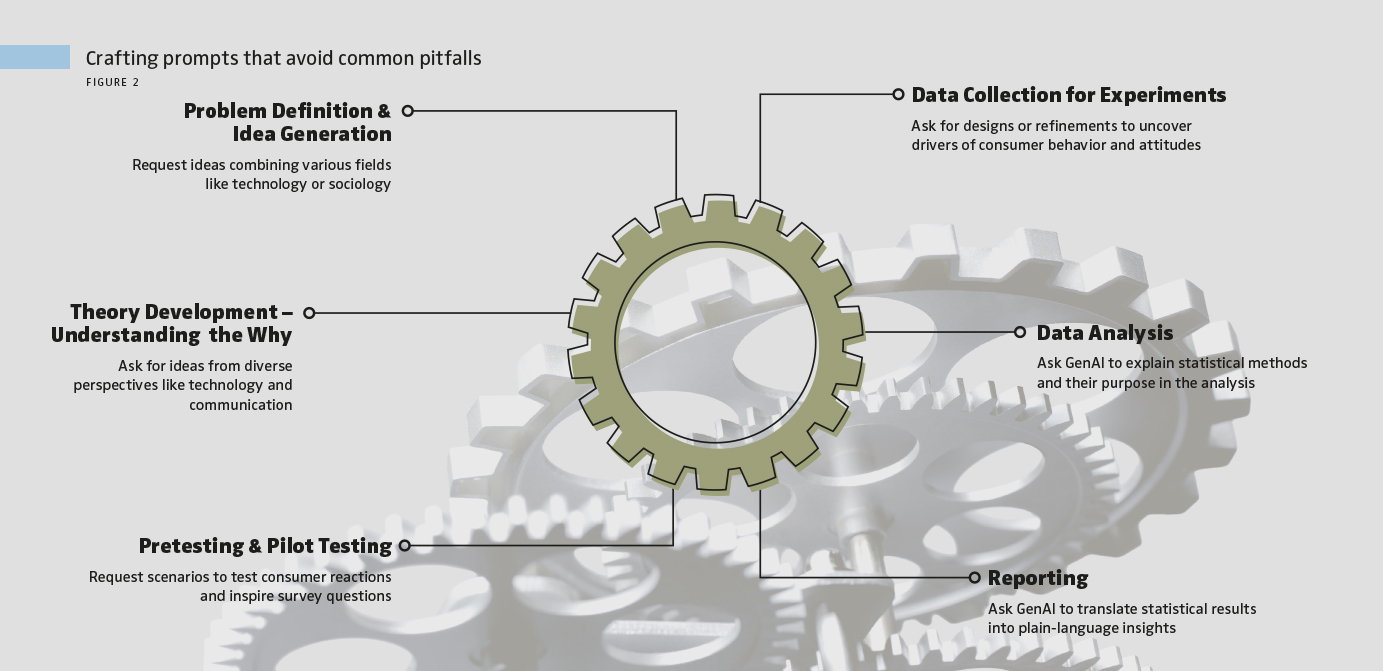
The first challenge in research is to turn a broad business issue into sharp, testable questions. GenAI excels at expanding the range of possibilities. For instance, “How can we improve customer engagement?” can quickly become more focused: “Which features would increase repeat visits?” or “How should we personalize messaging based on usage patterns?”
GenAI widens the funnel of options, but managers must prioritize the ideas that fit their strategy and are feasible. Treat GenAI’s suggestions as inputs and not answers, though. Human expertise remains essential for prioritizing ideas, assessing feasibility and ensuring brand fit. Teams that combine GenAI’s breadth with managerial judgment can enter the research process with sharper problem definitions and a clearer roadmap for testing solutions.
Stage 2: Theory development – understanding the why
At this stage, the goal is to explain why consumers behave as they do. GenAI can help by proposing plausible explanations, surfacing potential drivers and barriers, and framing hypotheses in clear “if–then–because” statements. Suppose a hotel chain sees a dip in online review scores. GenAI might suggest several explanations, such as slower service, less friendly staff or unclear pricing. Each can be framed as a testable statement: “If pricing is unclear, then guest satisfaction drops because customers feel misled.” Managers must then decide which explanations fit their market realities and are worth testing further. Yet judgment is critical. Managers must filter GenAI’s ideas through the lens of brand strategy, market realities and consumer context. GenAI sparks possibilities; people decide which explanations are credible.
Stage 3: Pretesting and pilot testing
Before rolling out large-scale research, teams must ensure that stimuli such as ads, product descriptions and survey items are clear and relevant. GenAI is a powerful accelerator here. It can draft multiple variations in seconds, highlight confusing language or suggest adjustments for different audiences, such as refining survey items or product descriptions. But beware: While GenAI can help refine materials, it cannot replace actual pretests with real consumers.
Human expertise remains essential for prioritizing ideas, assessing feasibility and ensuring brand fit.
Stage 4: Data collection for experiments
GenAI supports the nuts and bolts of data collection: writing survey items, refining instructions and generating experimental stimuli. This speeds setup and reduces errors. However, GenAI should be used cautiously in the place of real participants or to simulate human responses at scale, such as by creating synthetic data or silicon samples. Silicon samples are AI-generated “virtual consumers” that can answer survey questions or participate in experiments. While convenient, they risk misrepresenting actual consumer behavior and attitudes, producing insights that don’t hold up in the market. Managers should use GenAI to support the process while relying on real human participants and established research standards for the data itself.
Stage 5: Data analysis
GenAI can quickly summarize data patterns, generate simple visualizations and offer interpretations in plain language. This helps teams grasp early results and communicate them clearly. What it does not do reliably is run advanced statistical analyses or make causal claims. Managers should treat GenAI as a copilot for clarity, not as a substitute for robust analytics. Think of it as a partner that accelerates understanding – helping teams spot what is interesting – while leaving the heavy lifting of verification and decision-making to skilled analysts.
Stage 6: Reporting
GenAI can enhance reporting by turning complex findings into clear, concise narratives tailored to different audiences. It can help draft executive summaries and suggest ways to frame results in business-relevant language, which speeds up communication and improves clarity. It is also useful for generating alternative ways to present insights. Still, the final messaging and strategic interpretation should remain human-led to ensure accuracy, nuance and alignment with brand priorities. Managers should use GenAI to streamline report creation and sharpen storytelling while maintaining control over the conclusions and recommendations presented.
Avoiding the pitfalls of GenAI
Like any powerful tool, GenAI can create problems if used in the wrong way. Relying too heavily on silicon samples, expecting models to make causal claims or allowing outputs from one task to influence another without checks can all undermine credibility and weaken decisions. The goal is not to avoid GenAI, but to use it with clear boundaries. This section highlights the key “don’ts” every marketing manager and team should follow to capture GenAI’s benefits without putting quality or accuracy at risk. Figure 2, in contrast, captures the “dos” for each of the six steps – guidelines on how to prompt the AI for the best results. Several common missteps can undermine the value of GenAI in consumer research if left unchecked. Like any powerful tool, GenAI can backfire if misused. Three common traps stand out:
> Over-trusting synthetic consumers
Silicon samples can be useful for quick checks or brainstorming, so researchers should treat their input as helpful for shaping ideas or wording but always validate findings with real participants before making business decisions.
> Cross-task contamination
GenAI tools remember context within a session. If outputs from one stage such as idea generation) carry over into another (like theory development), bias can creep in. Restarting or clearly separating sessions ensures each stage stays objective and independent.
> Data governance gaps
Even when using GenAI responsibly, data privacy must remain a priority. Avoid feeding proprietary, customer or personally identifiable information into public AI tools. Establish internal guidelines for secure usage and make sure all team members follow them.
Guardrails like these can protect credibility while capturing the benefits of GenAI.
AI-powered human judgment wins
Used thoughtfully, GenAI can compress the research process, accelerate learning and improve clarity. The strategy is simple: Use it where it consistently helps, such as idea generation, theory development, pretesting and pilot testing, data collection, and reporting. The best research teams will harness GenAI as a smart partner, freeing people to focus on higher-value thinking while maintaining rigor, creativity and credibility in human hands.
FURTHER READINGS
Blythe, P. A., Kulis, C., McGraw, A. P., Haenlein, M., Hewett, K., Yoo, K., Wood, S., Morwitz, V. G., & Huber, J. (2025). Comments on “AI and the advent of the cyborg behavioral scientist.” Journal of Consumer Psychology, 35(2), 316–328. https://doi.org/10.1002/jcpy.1453
Yoo, K., Haenlein, M., & Hewett, K. (2025). A whole new world, a new fantastic point of view: Charting unexplored territories in consumer research with generative artificial intelligence. Journal of the Academy of Marketing Science, 53(3), 723–759. https://doi.org/10.1007/s11747-025-01097-2
Hewett, K. & Yoo, K. (2026). A New Frontier of Understanding: Where Generative AI Adds Real Value in Consumer Research. NIM Marketing Intelligence Review, 18(1), 17-23. https://doi.org/10.2478/nimmir-2026-0003
Other articles of the MIR issue “AI in Market Research”
Here you can find more exciting articles of this issue.