Study
 Download
Gangl, K., Zürn, M. K., & Biró, T. (2026). The "Right to Repair" under Scrutiny. A Study on Repair Culture in Germany in Light of New Political Framework Conditions. NIMpulse 20.
2026
Dr. Michael K. Zürn,
Tobias Biró
The "Right to Repair" Under Scrutiny
Background to the study
With Directive 2024/1799 on the "Right to Repair," the European Union aims to accelerate the transition to a sustainable circular economy. The new legislative requirements — which member states must transpose into national law by July 31, 2026 — are designed to strengthen consumers' rights, reduce electronic waste, and conserve resources.
Against this backdrop, and given the ongoing implementation process by the German federal government, the present study examines the current state of repair culture in Germany. To this end, in May 2026, NIM repeated a population-representative survey conducted in Germany in 2025 and supplemented it with additional questions.
The study addresses the following core questions: Has the passage of the EU legislation, along with the accompanying public discourse at the national level, already led to any shift in attitudes toward repair? How frequently do people in Germany actually have broken electronic devices repaired, and what barriers stand in the way? And what measures could ultimately help strengthen repair culture?
How often do people in Germany repair electronic devices?
On average, one smartphone breaks down per year in every fourth German household—approximately one in three of these is repaired. The repair rate is comparatively low for small household appliances. In the past year, 0.5 devices per household in this category broke down, and fewer than one in four were repaired. The average cost of a smartphone repair was €111; for coffee makers or vacuum cleaners, the figure was €64.
People in Germany would like to use a new smartphone for about five years. For computers and televisions, the expected lifespan without repairs is estimated at around eight to nine years. Small household appliances like coffee makers and vacuum cleaners are expected to last just under eight years. For large household appliances such as washing machines and refrigerators, the expected lifespan is around eleven years.
Willingness to pay for repairs has remained relatively stable in Germany over the past year. A relative majority of respondents are willing to pay up to 20% of the original purchase price for a repair. 30% were willing to pay up to 10% of the original purchase price (2025: 26%). Fewer than one in ten would be willing to pay 40% or more of the original purchase price for a repair.

Under what circumstances do repairs take place?
Among the stated reasons for choosing to repair, lower costs compared to purchasing a new device are cited most frequently (59%), followed by confidence that the product will function well again afterward (53%). However, neither of these two reasons is positively correlated with the actual likelihood of a repair being carried out. In practice, repairs are more likely to occur when the respondent is able to carry out the repair themselves, or when insurance coverage or a warranty exists.

What role does repairability play in smartphone purchasing decisions? Furthermore, how well-known and meaningful is the repair index?
When it comes to specific individual purchasing decisions, repairability still does not play a significant role. While battery life is important to 85 percent of people in Germany when buying a smartphone, this is only the case for 35 percent when it comes to repairability (compared to 42% in 2025).
Approximately one in six people in Germany has heard of the repairability index. Differences across demographic groups are modest. Awareness is slightly above average among men and older respondents. Only 4% of respondents have so far noticed the repairability index on a product in everyday life.

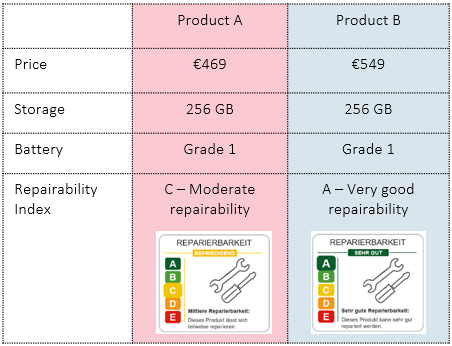
The results of an experiment conducted as part of the survey suggest that displaying repairability information can influence purchasing decisions. 65% of respondents chose the device with the better repairability rating. The remaining 35% opted for the less expensive but less repairable device.

How well-known is the 'right to repair,' and how popular is better repairability?
A majority of people in Germany appears to be only broadly familiar with the "Right to Repair" legislation. While 80% correctly identify the mandatory consumer information obligation under the new law, a widespread misconception simultaneously prevails: as many as 63% incorrectly assume that retailers will be legally required to carry out repairs. Moreover, 18% believe that repairing electronic devices will be free under the Right to Repair.
A large majority of people in Germany wish for electronic devices to be easier to repair. 55% of respondents share this wish on the condition that purchase prices do not increase as a result (2025: 53%). 29% are in favor even if new device prices were to rise slightly as a result (2025: 25%). The share of those who do not wish for easier repairability declined from 10% to 5%.

Authors
- PD Dr. Katharina Gangl, Director Studies, NIM, katharina.gangl@nim.org
- Dr. Michael K. Zürn, Senior Researcher, NIM, michael.zuern@nim.org
- Tobias Biró, Head of Research Communication, NIM, tobias.biro@nim.org
Contact