Brand, B.M.. & Unfried, M. (2026). Repurposing the Hangtag: Turning Sustainability into Sales in Fashion Retailing. NIM Marketing Intelligence Review, 18(2), 48-53. https://doi.org/10.2478/nimmir-2026-0017
Repurposing the Hangtag: Turning Sustainability into Sales in Fashion Retailing
Sustainability has become a central concern in the fashion industry. While consumers often claim they prefer environmentally and socially responsible products, their actual purchasing behavior tells a different story. This mismatch – commonly referred to as the intention-behavior gap – remains one of the biggest barriers to sustainable transformation in retail.
Rethinking sustainability communication: from static labels to rich media
Sustainability is a so-called credence quality: It is not possible to experience or verify it directly, even post-purchase. Therefore, informing consumers is important, also to counteract potential greenwashing concerns. Most fashion retailers already provide sustainability information – typically via small, text-heavy hangtags. However, these labels are often overlooked, difficult to read, or too abstract to meaningfully influence decisions.
Media richness theory argues that complex information requires richer communication formats. Sustainability, with its environmental, social, and economic dimensions, is inherently complex. Compressing it into a few lines of text can strip away nuance and reduce impact. Digital media, by contrast, are more accessible. They offer more space for storytelling, more entertainment via multimedia formats, including video, audio and visuals, and allow interactive engagement with consumers. Can these formats actually narrow the intention–behavior gap in the domain of sustainable fashion in retail?
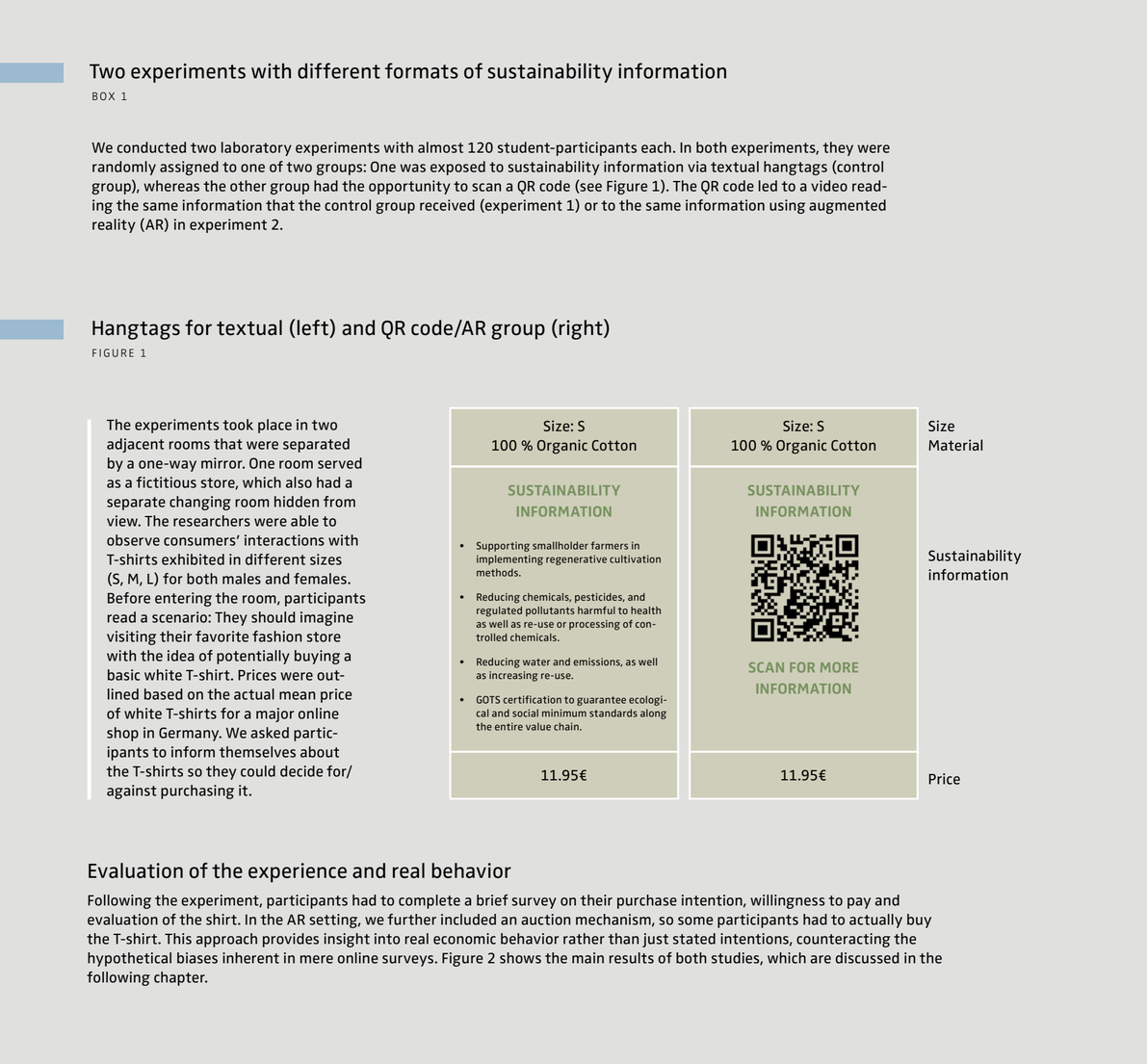
In our study, we shed light on this issue: Not just the availability of sustainability information, but how it is communicated. We examined whether digital formats, specifically QR codes linking to videos and augmented reality (AR), can make sustainability information more effective and ultimately influence real purchasing decisions. In two laboratory experiments, we investigated intentions plus actual purchases, allowing participants to try on T-shirts and satisfying the need for touch prevalent for fashion (see Box 1).
Richer media formats can improve perception and increase intent and willingness to pay
Richer digital communication formats improved both perception and significantly increased intention, whereas traditional labels seemed weaker at convincing consumers to buy sustainable product options.
> QR codes leading to sustainability information in a video significantly improved product evaluations and purchase intentions
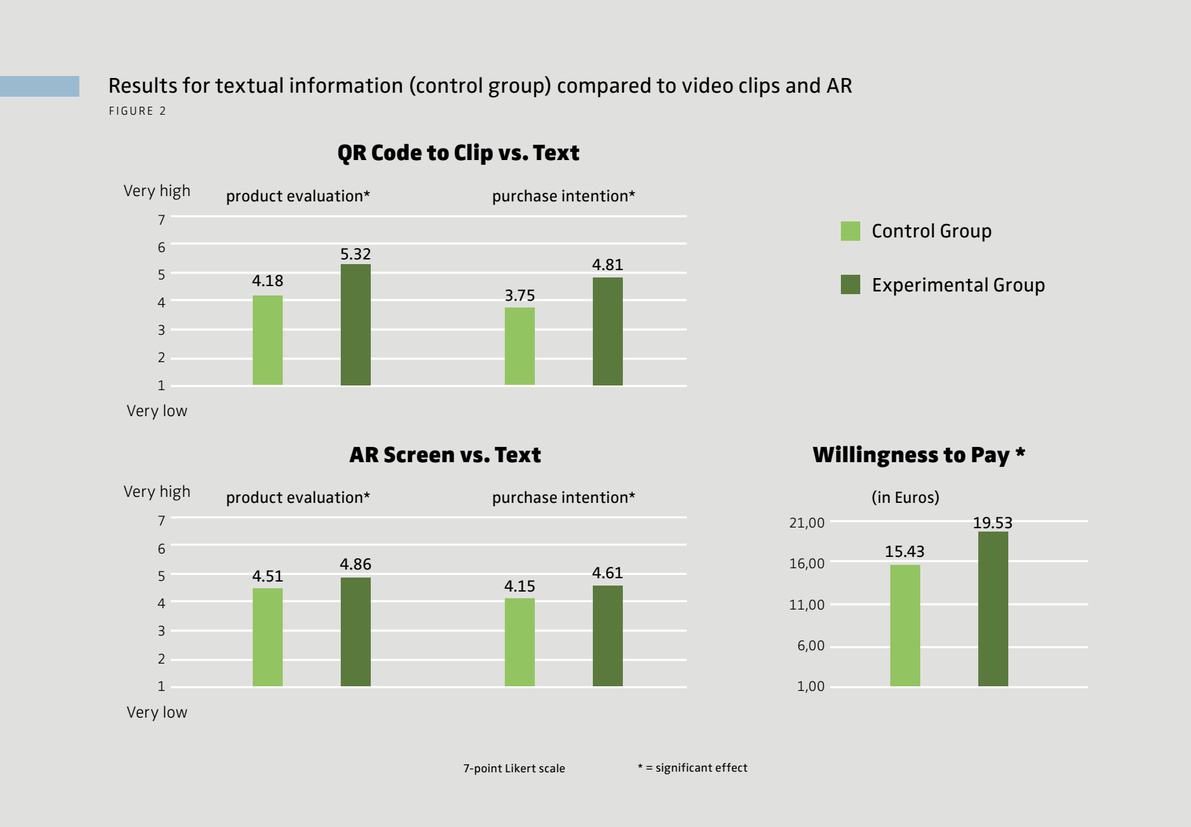
When sustainability information was delivered via QR code and video, product evaluation improved, and purchase intention increased significantly (see upper part of Figure 2).
> Augmented reality increased willingness to pay
In the AR setting, similar tendencies were observed: Participants showed higher purchase intentions and higher willingness to pay, which was also reflected in actual payments. Product evaluations were only marginally better. In other words, AR helped convert sustainability into economic value but did not dramatically change how consumers felt about a product (see lower part of Figure 2). Overall, the study's AR implementation slightly reduced the credibility of the information. This can likely be attributed to platform effects, as the AR filter was delivered via a social media interface. However, among consumers who viewed the sustainability information as credible, AR led to substantially more positive product evaluations and higher purchase intentions than textual information. The gap between “wanting to buy sustainably” and “actually doing it” got smaller.
Improving sustainability communication can pay off
Our findings suggest that improving how sustainability information is communicated can help consumers better evaluate sustainable fashion and, ultimately, drives sales. However, the lab setting may have made participants more aware of sustainability and more willing to engage with such information than in regular buying situations. Therefore, retailers should think of ways to highlight the topic in the first place. Sustainability communication should not be limited to hangtags. It should be integrated into brand communication in shops and other channels, as well as in bonus programs, to raise overall awareness and increase the likelihood that consumers engage. In addition to such motivational support, the following improvements to sustainability communication are worth trying.
> Use communication formats with fewer restrictions and more creative potential
Digital media channels enable much richer visualization of information through pictures, videos, music and even personalized content. Additional information about what is typically listed on a hangtag could further enhance the positive impression of sustainable products and their likelihood of purchase. Interestingly, the same fashion retailers often provide multimedia visualizations to illustrate information on textile sustainability on their online shops. Using digital formats in brick-and-mortar stores would also bridge this online-offline divide. In addition, QR codes used to access digital information could also integrate bonus programs or sales incentives, for instance, via retailer apps already installed on smartphones.
> Start with videos before offering AR
Managers should consider implementing QR codes that link to videos about sustainable products when the sustainable qualities are complex. Given that consumers were actually paying more for sustainable T-shirts using AR, using digitalized information seems to be a promising way to offset the higher production costs inherent in many sustainable products. Since QR codes are more prevalent in consumers’ shopping than AR and had larger effects in our experiment, it is advisable to focus on this way of communicating sustainability information first.
> Convenience is king
Short videos are a very popular form of communication among the younger generation. Many consumers turn to YouTube, Instagram, or TikTok for information on financial investment strategies, cooking recipes, and more. It seems that using this convenient format is also effective for sustainability information. While getting the information directly on a hangtag requires active reading, the video in our experiment read the information to the consumer, thus making information processing easier. By using preferred and convenient formats, retailers are more likely to reach consumers with sustainability information.
Creating win-win situations with better sustainability communication
The textile industry’s environmental footprint is substantial. It accounts for a striking share of global emissions, water degradation and land use. Increasing the market share of sustainable textiles, therefore, represents an impactful step toward reducing environmental harm. While many consumers are aware of these facts and intend to buy accordingly, they still seem to need confirmation at the point of sale. Fashion retailers can encourage their consumers to follow through with their intentions by doing a better job at explaining the value of sustainable fashion. One way to achieve this is to repurpose hangtags as gateways to more engaging digital sustainability communication formats rather than direct carriers of text-based information. Based on our findings, experimenting with QR codes linking to richer media such as video clips or AR-framed environments can pay off in several ways: For shops by spurring sales of sustainable textiles at higher price levels, for consumers by helping them to live up to their intentions and for our planet by reducing the environmental footprint. Overall, this creates a win-win situation in which improved sustainability communication not only closes information gaps but also supports tangible behavioral changes in the purchasing process.
FURTHER READING
Brand, B. M. (2025). Bridging the intention-behavior-gap through digitalized information (?): Two laboratory experiments in the textile industry. Journal of Retailing and Consumer Services, 84, 104179. https://doi.org/10.1016/j.jretconser.2024.104179
White, K., Habib, R., & Hardisty, D. J. (2019). How to SHIFT consumer behaviors to be more sustainable: A literature review and guiding framework. Journal of Marketing, 83(3), 22–49. https://doi.org/10.1177/0022242919825649
Zürn, M. K., Unfried, M., Weber, N. J., & Buder, F. (2025). Von Zahlen, Bildern und Worten: Empirische Befunde zur überzeugenden Nachhaltigkeitskommunikation. transfer, (3).
Other articles of the MIR issue “Sustainable Sustainability: What Works, What Backfires and What's Next”
Here you can find more exciting articles of this issue.