Cakanlar, A. (2026). Why Sustainability Polarizes: And How to Bridge the Divide. NIM Marketing Intelligence Review, 18(2), 24-29. https://doi.org/10.2478/nimmir-2026-0013
Why Sustainability Polarizes and How to Bridge the Divide
Sustainability discourse is often intended to unite consumers around a shared goal: protecting the environment. Yet the same messages designed to inspire collective action can also provoke resistance, skepticism and polarization. This dynamic can be observed across policy, corporate behavior and everyday consumer decisions. For example, when the Green New Deal was first introduced in the United States, public awareness was low, and support was broadly positive across party lines. Within months, however, as awareness grew, support among conservatives declined sharply. A similar divide appears in the corporate sphere. Some companies openly embrace environmental activism and advocate systemic change. For example, Patagonia has positioned itself as a vocal champion of environmental causes. Others, particularly in carbon-intensive industries, have lobbied against stricter environmental regulations. These divisions extend beyond policy debates or corporate positioning. Conservatives and liberals differ in the extent to which they attribute climate change to human activity, and similar divides appear in everyday choices. In one study, conservatives and liberals showed similar intentions to bike to work when it was framed as promoting health, but conservatives’ intentions declined when it was framed as environmentally motivated.
Psychological drivers elicit political differences in reactions to sustainability
These patterns raise an important question: when and why do sustainability cues trigger negative or polarized reactions, and what strategies can we use to reduce these effects? Understanding the psychological drivers of these responses is essential for designing sustainability messages that resonate with audiences across ideological lines rather than divide them. Two key drivers explain these polarized responses to sustainability: differences in personal values, which shape how conservatives and liberals interpret and engage in sustainable behaviors and the influence of in-group norms, which guide how each group perceives and adopts such behaviors.
Personal values shape the interpretation of messages and offerings
Liberals and conservatives differ in the values they prioritize, such as how strongly they view existing economic and social arrangements as legitimate, which in turn shapes how they interpret sustainability messages.
> Speaking different moral languages can broaden engagement
Political ideology is rooted in distinct moral priorities. While liberals tend to prioritize equality, protection from harm and fairness, conservatives place greater weight on loyalty, duty to institutions such as family or nation and respect for tradition and social order. These differences in which values are emphasized have important implications for how environmental communication is viewed and how it should be designed. For instance, environmental communications often frame climate change in terms of harm and fairness. Examples include emphasizing species extinction, environmental injustice affecting vulnerable communities or threats to future generations. Such framing naturally resonates with liberal audiences, given their stronger emphasis on avoiding harm and seeking fairness, which can strengthen their engagement in sustainable behavior. However, this type of messaging may be less motivating for conservatives, whose moral priorities differ.
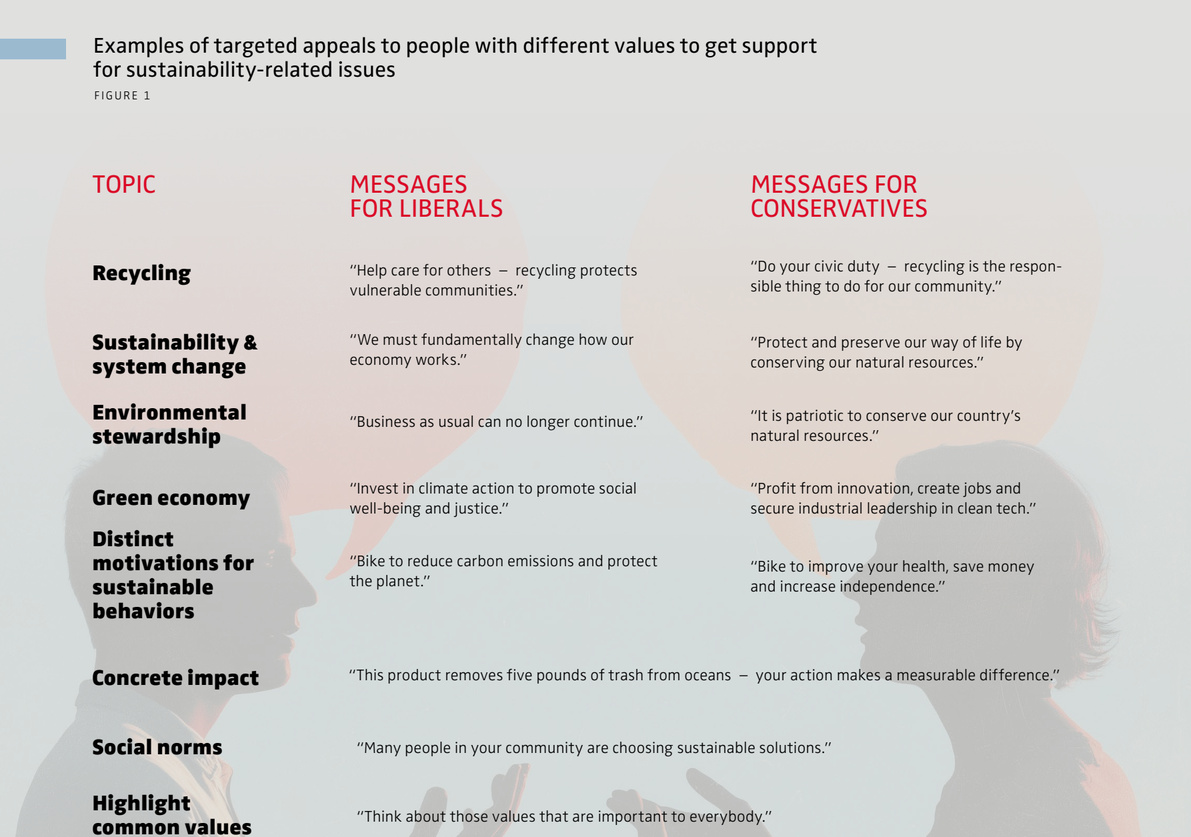
Fortunately, sustainability messages can be tailored to resonate with different ideological audiences without altering the underlying environmental goal. The same behavior can gain broader support when framed in terms of values that align with different groups’ moral priorities. For example, messages emphasizing civic duty and responsibility increase recycling among conservatives, whereas messages highlighting care and collective well-being are more effective among liberals. Tailoring messages to audiences’ values thus broadens engagement with sustainable behaviors. Some messages can be used successfully across the divide (see Figure 1 for additional examples).
> The status quo problem: defend or change?
Another key divide between conservatives and liberals lies in their views on the legitimacy of the current socioeconomic system. Conservatives are more likely to see existing economic and social arrangements as fair and legitimate and to prefer keeping things as they are. In contrast, liberals are more open to structural change. This difference shapes how each group approaches environmental issues. Acknowledging environmental problems often requires recognizing that prevailing patterns of production and consumption are unsustainable and must change, which implies a departure from the status quo. For example, in the context of business, environmental progress requires shifting from the traditional “take-dispose” model to circular approaches that emphasize reuse, repair and regeneration. For consumers, sustainability can mean shifting everyday habits: repairing products instead of replacing them, choosing durable goods over fast fashion or simply buying less. Because these changes challenge established routines and economic arrangements, sustainability can feel at odds with preserving familiar ways of living and doing business. It may seem threatening to those motivated to defend the existing system.
As a result, sustainability cues may signal necessary progress to some audiences but a systemic threat to others, particularly conservatives, who are generally more motivated to preserve the status quo. When sustainability is framed as requiring disruption to established ways of doing things or valued ways of life, conservatives show greater resistance to sustainable initiatives.
For marketers, this motivational dynamic has an important implication: sustainability messages do not always need to emphasize disruption or departure from current practices. One effective approach is to position sustainable behavior as a means of protecting and preserving valued ways of life, for example, by emphasizing that environmental stewardship safeguards communities and resources. Framed this way, sustainability aligns with preserving valued ways of life rather than disrupting them, which can increase conservatives’ engagement in sustainable behaviors.
Polarization around sustainable behavior can be reduced by reframing sustainable actions to connect with motivations already present in the audience.
> Preserving versus constraining the free market economy
Reactions to climate solutions are also shaped by differences in how ideological groups view the roles of both markets and government. Conservatives tend to emphasize free markets and limited government intervention, favoring an economic system in which businesses operate with substantial autonomy. Liberals, by contrast, are more inclined to see regulation as a legitimate means of protecting fairness and promoting broad societal well-being. These contrasting economic perspectives influence how proposed climate change solutions are interpreted.
Many widely discussed climate change solutions, such as carbon taxes, emissions standards and single-use plastic bans, can be perceived as constraints on markets and business autonomy. For instance, many business leaders and consumers view a carbon tax as a government-imposed cost on energy, transportation and production inputs and therefore as an external intervention that limits companies’ freedom to operate independently. When climate solutions are perceived as conflicting with free-market principles, support tends to polarize, with conservatives, who place greater value on market autonomy, less likely to endorse such initiatives. Similar perceptions surfaced during the COVID-19 lockdowns, when reports of cleaner air and lower emissions resulting from shutdowns were, in some conservative discourse, framed as evidence that environmental gains come at the expense of economic growth.
One way to overcome this challenge is to frame sustainable solutions as free market-friendly rather than market-constraining. Emphasizing opportunities for innovation, green jobs, industrial leadership and competitive advantage, for example, positioning climate action as a pathway to global leadership in clean technology, can increase conservative support compared with framing the same policies purely as regulation.
The Power of In-group Norms
Beyond differences in personal values, ideological divides can also be shaped by in-group norms – how members of one’s social group behave – as well as by sustainability-related motivations that extend beyond environmental benefits.
> Less engagement when topics are less present in social life
Polarization in sustainable behavior is also shaped by the social norms people observe within their own groups. Individuals tend to interact primarily with like-minded peers and rely on their social circles to infer which behaviors are typical, appropriate and valued. When sustainable actions are not visibly practiced or discussed within one’s in-group, they can appear uncommon, which reduces motivation to adopt them.
This dynamic may help explain lower engagement in sustainable behavior among conservatives. Compared with liberal contexts, conservative media environments often feature fewer visible examples of climate-related behaviors or environmental advocacy. As a result, sustainability may seem uncommon within their in-group, leading conservatives to generalize from these local observations and conclude that such behaviors are not prevalent. These perceptions can reinforce conservatives’ belief that individual actions have little environmental impact, leading them – even when they believe in climate change – to underestimate the impact of sustainable behaviors compared to liberals, which further reduces their willingness to engage.
> Linking desired outcomes with alternative benefits and concrete results
Polarization around sustainable behavior can be reduced by reframing sustainable actions to connect with motivations already present in the audience and by correcting misperceptions about their environmental impact. For instance, many sustainable actions offer multiple benefits. Buying energy-efficient light bulbs can be framed not only as environmentally friendly but also as a way to save money. Emphasizing these non-environmental advantages can increase engagement among conservative audiences, whereas environmental benefits often resonate more strongly with liberals, for whom pro-environmental norms are already salient.
Moreover, making the environmental impact of sustainable behaviors explicit and easy to understand can increase engagement. When the results of individual actions are clearly communicated, conservatives are less likely to underestimate their effectiveness and more willing to act. Regarding social norms, emphasizing the prevalence of sustainable behaviors within one’s in-group can increase willingness to engage across the ideological spectrum.
Given that both conservatives and liberals tend to follow the norms and cues of their ideological groups, another promising approach is to shift attention away from partisan in-group norms. Emphasizing broader, shared identities, such as a national identity instead of a partisan identity, can reduce ideological divisions in the sustainability domain. Likewise, prompting individuals to reflect on values that resonate across political groups can reduce the salience of political labels and promote sustainable behaviors.
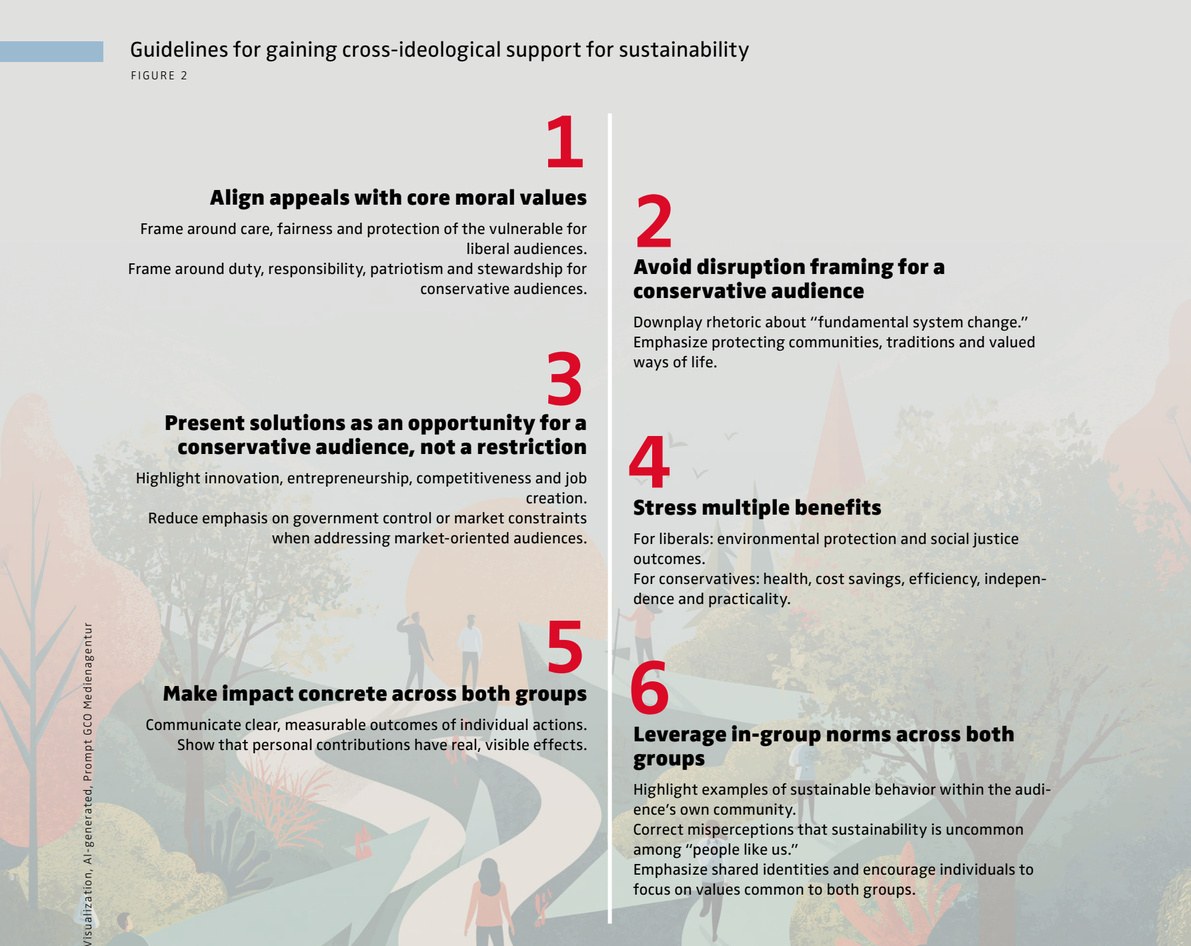
Bridging the sustainability divide through strategic messaging
While polarization around sustainability stems from broader sociopolitical dynamics, marketers still strongly influence how sustainable behaviors are perceived, framed and normalized. Figure 2 summarizes recommendations for reaching out to different audiences. Marketing communication strategies may help increase sustainable behavior among less engaged groups, but tailoring requires careful consideration and can carry risks: messages that resonate with one audience may alienate others. In the social media era, communication rarely stays within targeted channels, so tailored messages can reach unintended audiences and produce mixed outcomes. If backlash occurs, shifting to more inclusive frames that emphasize shared identities and common goals can reduce resistance while sustaining engagement with sustainability initiatives.
Therefore, addressing the deeper roots of political polarization is equally important. Reducing the sense of anonymity and distance between groups may help foster mutual understanding. For example, emphasizing that climate action can bring people together and improve societal well-being may also foster more positive attitudes among climate skeptics and reduce polarization between groups. Thus, effective sustainability communication must combine audience-specific framing with broader narratives that reinforce common ground and collective purpose.
FURTHER READINGS
Cakanlar, A. (2024). Breaking climate change polarization. Journal of Public Policy & Marketing, 43(4), 276–294. https://doi.org/10.1177/07439156241244737
Cakanlar, A., White, K., & Trudel, R. (2026). The politics of impact: How political ideology shapes perceptions of the environmental impact of individual actions. Journal of Consumer Psychology. Advance online publication. https://doi.org/10.1002/jcpy.70020
Campbell, T. H., & Kay, A. C. (2014). Solution aversion: On the relation between ideology and motivated disbelief. Journal of Personality and Social Psychology, 107(5), 809–824. https://doi.org/10.1037/a0037963
Feygina, I., Jost, J. T., & Goldsmith, R. E. (2010). System justification, the denial of global warming and the possibility of “system-sanctioned change”. Personality and Social Psychology Bulletin, 36(3), 326–338. https://doi.org/10.1177/0146167209351435
Other articles of the MIR issue “Sustainable Sustainability: What Works, What Backfires and What's Next”
Here you can find more exciting articles of this issue.