Publikationen
Kaiser, C., Langer, M., Schelhorn, T., & Mädche, A. (2025). From Clicks to Conversations. The Rise of Conversational Online Shops. NIM Insights Research Magazin Vol. 8 - AI.Meets.Consumer.
2025
From Clicks to Conversations

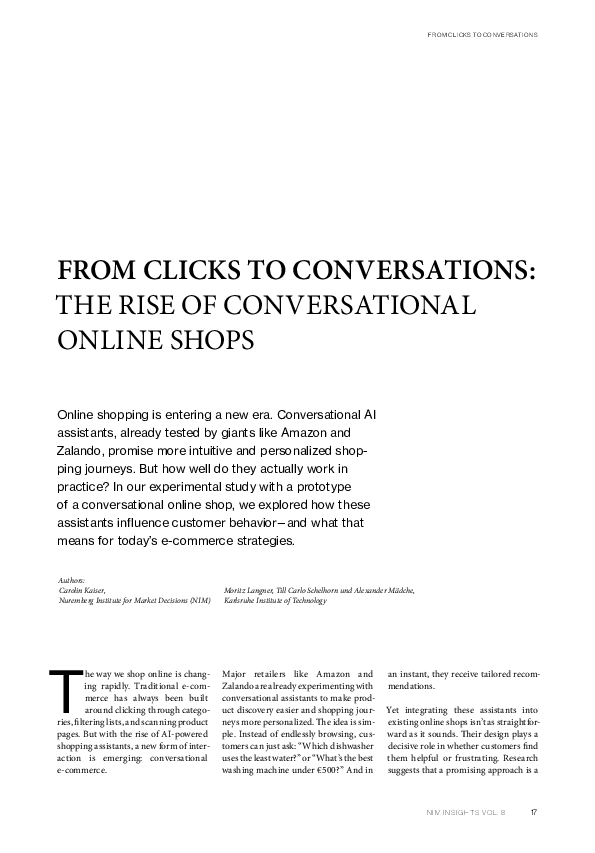
Online shopping is entering a new era. Conversational AI assistants, already tested by giants like Amazon and Zalando, promise more intuitive and personalized shopping journeys. But how well do they actually work in practice? In our experimental study with a prototype of a conversational online shop, we explored how these assistants influence customer behavior—and what that means for today’s e-commerce strategies.
The way we shop online is changing rapidly. Traditional e-commerce has always been built around clicking through categories, filtering lists, and scanning product pages. But with the rise of AI-powered shopping assistants, a new form of interaction is emerging: conversational e-commerce.
Major retailers like Amazon and Zalando are already experimenting with conversational assistants to make product discovery easier and shopping journeys more personalized. The idea is simple. Instead of endlessly browsing, customers can just ask: “Which dishwasher uses the least water?” or “What’s the best washing machine under €500?” And in an instant, they receive tailored recommendations.
Yet integrating these assistants into existing online shops isn’t as straightforward as it sounds. Their design plays a decisive role in whether customers find them helpful or frustrating. Research suggests that a promising approach is a hybrid model, one that lets users fluidly switch between traditional browsing and conversational interactions. This flexibility increases transparency, reduces friction, and supports decision- making.
With this in mind, our study set out to answer two critical questions: How should conversational online shops be designed to enable effective use? And how do they actually influence consumer behavior and decision-making?
Elektroshop: A Prototype for Exploring the Future
To explore how conversational e-commerce changes shopping behavior, we developed Elektroshop, a prototype of an online store blending traditional browsing with an AI-powered assistant.
On the surface, Elektroshop looked like a regular e-commerce site, complete with categories, filters, and product pages. It offered around 300 real household appliances, with product data drawn from existing retail sources. The difference was that shoppers could also interact with an assistant powered by OpenAI’s GPT technology—asking questions using natural language, comparing products instantly, or filtering by specific needs.
This hybrid approach was intentional. Instead of forcing customers to choose between browsing or conversation, Elektroshop let them fluidly switch between the two. That flexibility allowed us to study not just usability but also how consumers actually combine these modes when making purchase decisions.
Putting It to the Test: How Shoppers Really Behave
To see how conversational assistants influence behavior, we conducted an incentivized laboratory experiment with 70 participants, most of them students with digital experience. Their mission was realistic: shop for three household appliances for an elderly family member. They had to meet certain requirements and choose the cheapest option that fit.
Participants were randomly assigned to one of two groups. The baseline group (n=36) could only use the traditional online shop, while the treatment group (n=34) had access to the same shop with the conversational assistant included (hybrid shop). Each participant practiced first, then completed two main shopping rounds. Along the way, we measured their performance and collected feedback through surveys and interviews. Crucially, we also used eye-tracking technology to observe how participants searched, compared, and interacted with the site. This gave us a richer picture of not just what they chose but also how they arrived at their decisions.
KEY INSIGHTS
- Efficiency is the main hurdle: Conversational in-store assistants didn’t improve decision quality, but they did slow down the process. For marketers, the challenge is to design assistants that are fast, clear, and reliable.
- Customer experience depends on speed and clarity: Shoppers appreciated assistants embedded in online stores that responded quickly and gave transparent, reliable answers. Slow or vague interactions eroded confidence and reduced satisfaction.
- The marketer’s role will shift: As AI platforms like ChatGPT and Gemini begin to support purchasing directly within the chat, the focus will move from optimizing shop design to embedding brands within conversations—turning dialogue itself into the new storefront.
Surprises in Shopper Behavior
The experiment revealed some surprising insights.
First, the conversational assistant did not replace the traditional shop; it complemented it. Shoppers continued to browse, filter, and compare products in the usual way, but they also turned to the assistant as an extra tool. This hybrid use shows that, at the moment, conversational e-commerce is about enhancing rather than replacing the old model.
Second, the assistant did not increase mental workload. Participants didn’t find shopping to be more cognitively demanding, which is a positive signal for AI adoption. However, efficiency was an issue. Shoppers using the online shop with the conversational assistant were slower than those relying solely on traditional browsing. They often double-
checked results or repeated steps to be sure that they were making the right decision. Interestingly, their decision quality and satisfaction remained just as high as the group with the traditional shop. In other words, they didn’t make worse choices, they just took longer to get there.
Finally, the eye-tracking data revealed intriguing patterns. Participants who directed more visual attention toward the traditional shop tended to require more time to complete their tasks, whereas actual interactions with the shop were associated with shorter task completion times. This suggests that increased visual attention toward the shop reflects exploratory behavior, whereas direct interaction signifies more goal-directed behavior.
What Shoppers Loved and What Frustrated Them
Numbers tell part of the story, but interviews with participants brought it to life. Shoppers valued the assistant most when it was fast, transparent, and backed by reliable data. They appreciated clear, direct suggestions that helped them narrow down options quickly.
At the same time, trust was fragile. When responses were slow, vague, or incomplete, participants lost confidence and began double-checking, which slowed them down. The assistant’s tone also mattered; a friendly, conversational style made the interaction feel more engaging and human.
Conversational E-Commerce: The Next Frontier for Marketers
Conversational assistants are reshaping online shopping, but the results are mixed. They haven’t yet made customers better at choosing products, and they often slow down decision-making by adding extra steps. This raises big questions for marketers. Are current AI tools underperforming, or do shoppers still need to learn how to use them effectively? Which categories naturally benefit from dialogue, and which purchases resist it?
At present, retailers are experimenting with hybrid models that combine familiar browsing interfaces with chat-based assistance. This blend reflects a transitional stage: customers can rely on what they know while testing the convenience of conversation. But it may not stop there. Platforms such as OpenAI ChatGPT and Google Gemini are already piloting “buy within the chat,” signaling a future where the entire shopping journey—from discovery to purchase—takes place within the dialogue.
If such a future unfolds sooner than expected, marketers will need to pivot from optimizing store layouts to seamlessly embedding brands into conversations, powered by accurate product data, trust, and human-like interaction. The challenge today is to design effective hybrids. The opportunity tomorrow is to master fully conversational e-commerce. The key question is: How fast will the shift come, and will your brand be ready?
Autorinnen und Autoren
- Dr. Carolin Kaiser, Head of Human-Technology Interaction, NIM, carolin.kaiser@nim.org
- Moritz Langner, KIT
- Till Carlo Schelhorn, Karlsruher Institut für Technologie
- Prof. Dr. Alexander Mädche, Professor, Karlsruher Institut für Technologie
Kontakt

Weitere Artikel der Ausgabe “NIM INSIGHTS Research Magazin VOL. 8”
Hier finden Sie weitere spannende Artikel dieser Ausgabe.