Publikationen

Kaiser, J. (2025). Global Technology Climate: Who Embraces and Who Fears New Technologies? NIM Insights Research Magazin Vol. 8 - AI.Meets.Consumer
2025
Global Technology Climate
A comprehensive global study reveals a striking paradox. Citizens in wealthier countries are significantly less optimistic about new technologies than those in emerging economies, despite being better positioned to benefit from innovation.
The Challenge: What Drives Fast vs. Slow Technology Adoption?
We are living through a period of significant technological upheaval. New technological trends like artificial intelligence may fundamentally alter how we work and interact with each other. Businesses wanting to thrive in the future ignore such changes at their peril. Indeed, business leaders consistently advocate for the proactive integration of new technologies as the pathway to future prosperity.
Yet technological transformation cannot be mandated by decree alone. The decisive factor lies in people’s willingness to experiment with innovations and integrate them into their daily work routines. Understanding public attitudes toward technological change has become essential for leaders navigating an increasingly complex global innovation landscape. But why do new technological trends evoke excitement and optimism in some people, while others are more likely to be skeptical of their potential downsides? A new large-scale study by the Nuremberg Institute for Market Decisions (NIM) sheds light on what really drives attitudes toward current technological trends across the globe.
Research Methodology
The research team conducted a representative global study of over 25,000 people across 25 nations between December 2024 and March 2025. The sample included almost all G20 countries (except China, Russia, and Saudi Arabia). Additional countries were selected to ensure balanced representation of advanced and emerging economies following International Monetary Fund (IMF) classifications. Overall, this study sample represents approximately 40% of the world population and 68% of world GDP. This research thus constitutes a highly unique and comprehensive examination of citizens’ thoughts and feelings about new technologies. The researchers assessed respondents’ general expectations about “new technologies” and their anticipated effects over the next five years. Importantly, rather than focusing on specific preselected technologies, participants were asked to identify what they currently see as the most important technological developments. This approach allowed researchers to measure participants’ general feelings about current technological developments. Participants rated the expected impact of new technologies across several dimensions, including their personal economic situation, their personal happiness, and national economic wellbeing. Based on these individual responses across several life domains, the researchers created a summary Technology Climate Score for analysis. This method provided an empirical measure of how nations on average, as well as individual citizens, feel about current technological trends.
Key Results
Economic Wealth vs. Technology Optimism
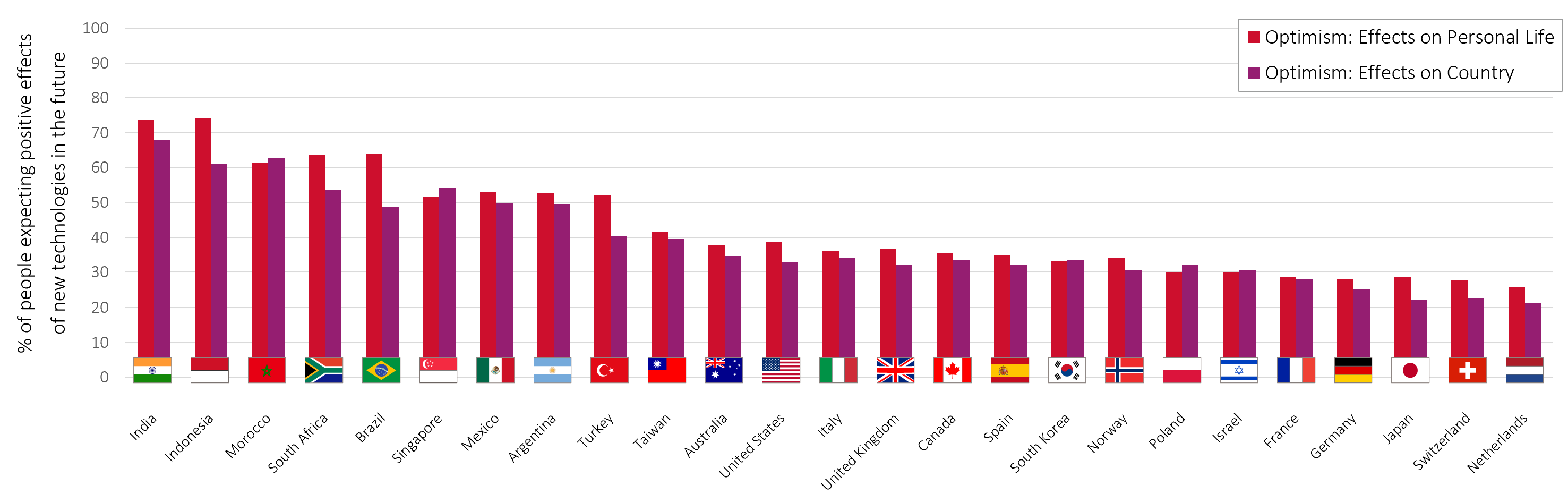
Globally, 70% of respondents expect more technological change in the next five years compared to the previous five years. This expectation of acceleration remains consistent across countries, though emerging economies show slightly higher rates of anticipated change. Notably, on average, citizens in wealthy nations express lower technology optimism despite their countries’ often superior technological infrastructure and capabilities. The study reveals a strong negative correlation between GDP per capita and technology optimism. Countries with higher per-capita incomes consistently show lower levels of public enthusiasm for technological change. This relationship remains statistically significant even when controlling for demographic differences between countries such as age and education levels. This pattern contradicts expectations that technologically advanced nations would be most receptive to innovation. This suggests that technical capability and public sentiment operate independently, creating potential misalignments between national technology strategies and citizen support.
Demographics vs. Values
On an individual level, demographic factors predict attitudes toward technology: younger individuals, those with higher education and higher incomes, and, on average, men tend toward greater technology optimism. But the researchers also examined people’s personal values using a standardized psychological questionnaire that determines the personal importance of values such as social life, career, altruism, and security. Interestingly, personal values prove to be more predictive than demographic characteristics alone. Career orientation emerged as the single strongest predictor of technology optimism: individuals who strongly value professional success show consistently higher technology enthusiasm regardless of age, income, or education level. This demonstrates that while sociodemographic factors certainly play a role in shaping individuals’ sentiments about new technologies, personal values provide deeper insights into attitudes toward technology.
Artificial Intelligence and Inequality Concerns
When asked to identify specific “new technologies” that are currently highly relevant, respondents mentioned artificial intelligence (AI) more frequently than any other innovation. This shows that AI is top of mind for most people when thinking about the future of technology. However, public sentiments toward AI remain deeply ambivalent. Only 35% of respondents view AI as primarily beneficial, while 45% expect both positive and negative effects, and 18% consider it primarily harmful. In general, people across the world are currently skeptical that new technologies will improve their lives. Across nearly all the surveyed countries, most respondents expect new technologies to increase unemployment rather than create jobs. This fear represents the most frequently mentioned concern about technological progress. Similarly, most respondents believe that wealthy individuals will benefit disproportionately from new technologies compared to economically disadvantaged groups. This perception exists across countries with varying levels of inequality and social protection, suggesting deep-seated concerns about technology’s effects on social cohesion. How should governments respond to such concerns? A majority of respondents in most countries believe governments should take primary responsibility for ensuring that new technologies benefit citizens. However, significant portions of respondents doubt their governments’ capability to fulfill this role effectively. This gap between expected responsibility and perceived capability indicates that politicians need to demonstrate that they can effectively address citizens’ concerns regarding the impact of new technologies.
Implications and Strategic Considerations
The global divide in technology optimism presents both challenges and opportunities for businesses operating across international markets. Companies must navigate vastly different public expectations and concerns when deploying new technologies globally. Success requires understanding that technology adoption involves more than technical feasibility. Organizations should develop differentiated strategies that acknowledge these varying expectations, address specific regional concerns, and leverage the enthusiasm present in emerging markets while managing skepticism in advanced economies. The research suggests that personal values—particularly career orientation—offer more reliable predictors of technology receptivity than traditional demographic targeting, indicating opportunities for more sophisticated market segmentation approaches.
Key Insights
- Adoption hinges on sentiment, not just access: Even in markets with advanced infrastructure, skepticism toward new technologies can slow adoption. Businesses must account for public attitudes, not just technical readiness.
- Emerging markets are growth opportunities: High levels of optimism in developing economies mean these regions may be more open to experimenting with new technologies. Companies can position innovations as enablers of opportunity and progress here.
- Values matter more than demographics: Career orientation and personal aspirations are stronger predictors of technology acceptance than age, income, or education. This opens opportunities for more precise segmentation and targeted communication strategies.
- AI is the flashpoint: Artificial intelligence dominates public awareness but elicits mixed reactions. Leaders should address this ambivalence directly by balancing narratives of opportunity with clear strategies to mitigate risks like job loss or inequality.
- Trust in governance is fragile: Many citizens expect governments to ensure that technology benefits society, but confidence in their ability to do so is low. Businesses that demonstrate responsibility, transparency, and fairness can address part of this trust gap and thus strengthen their customer relations.
Autorinnen und Autoren
- Dr. habil. Jakob Kaiser, Senior Researcher, NIM, jakob.kaiser@nim.org
Kontakt

Weitere Artikel der Ausgabe “NIM INSIGHTS Research Magazin VOL. 8”
Hier finden Sie weitere spannende Artikel dieser Ausgabe.